
The simplest way to understand volleyball rotation is this: when a team receiving the serve wins the rally, its six players rotate one position clockwise, and the team gets the right to serve. The libero is different because this specialist defender does not follow the normal front-row rotation and can replace players only in back-row positions.
That small distinction explains one of the most confusing parts of indoor volleyball. A player can move around the court after the serve, but the team must be in the correct rotational order when the serve is hit. The libero can enter and leave the back row repeatedly, but cannot serve, block or complete an attack hit when the ball is entirely above the top of the net.
Volleyball Rotation Rules

Image Source: Twitter
Indoor volleyball has six players on the court. They occupy six positions:
- Position 1: Right back
- Position 2: Right front
- Position 3: Middle front
- Position 4: Left front
- Position 5: Left back
- Position 6: Middle back
The three players closest to the net are the front-row players, while positions 5, 6 and 1 form the back row.
When the receiving team wins a rally, it gains the right to serve and rotates one position clockwise.
The sequence is:
Position 1 → Position 6 → Position 5 → Position 4 → Position 3 → Position 2 → Position 1
This means the player who moves into position 1 becomes the server.
For example, if a team wins a rally while receiving serve, the player at position 2 moves to position 1 and serves. The player at position 3 moves to position 2, position 4 moves to 3, and so on.
Do Players Have to Stay in Their Positions?
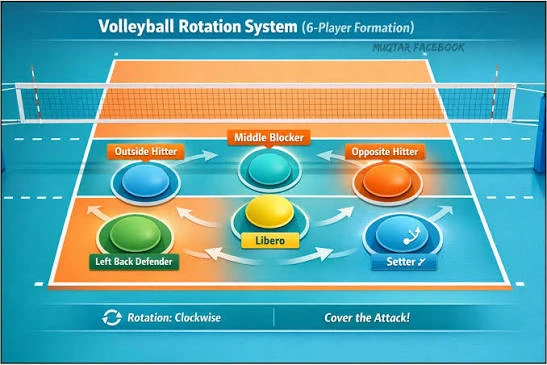
Image Source: Twitter
Only at the crucial moment of service.
Under the FIVB rules, the receiving team must be in the correct rotational order when the server hits the ball. Meanwhile, the serving team can occupy any positions at that moment.
Once the serve has been hit, players can move around their own court and free zone.
This is why a setter may start a rally in a seemingly unusual position and immediately move toward the net. The player must satisfy the rotation requirement first; after the service contact, tactical movement can begin.
If players are incorrectly positioned when the serve is hit, the team commits a positional fault.
What Is a Libero in Volleyball?
The libero is a specialist defensive player introduced by the FIVB in 1998. A jersey easily identifies the player with a different dominant colour from the rest of the team.
The libero's main job is reception and back-row defence.
Under the current FIVB rules, a team can designate up to two Liberos. Only one Libero can be on court at a time.
The biggest difference is that the libero does not operate like an ordinary substitute.
A libero can replace any player in a back-row position. This allows teams to bring a strong defensive specialist into the game when a front-row attacker rotates into the back court.
Can a Libero Serve?
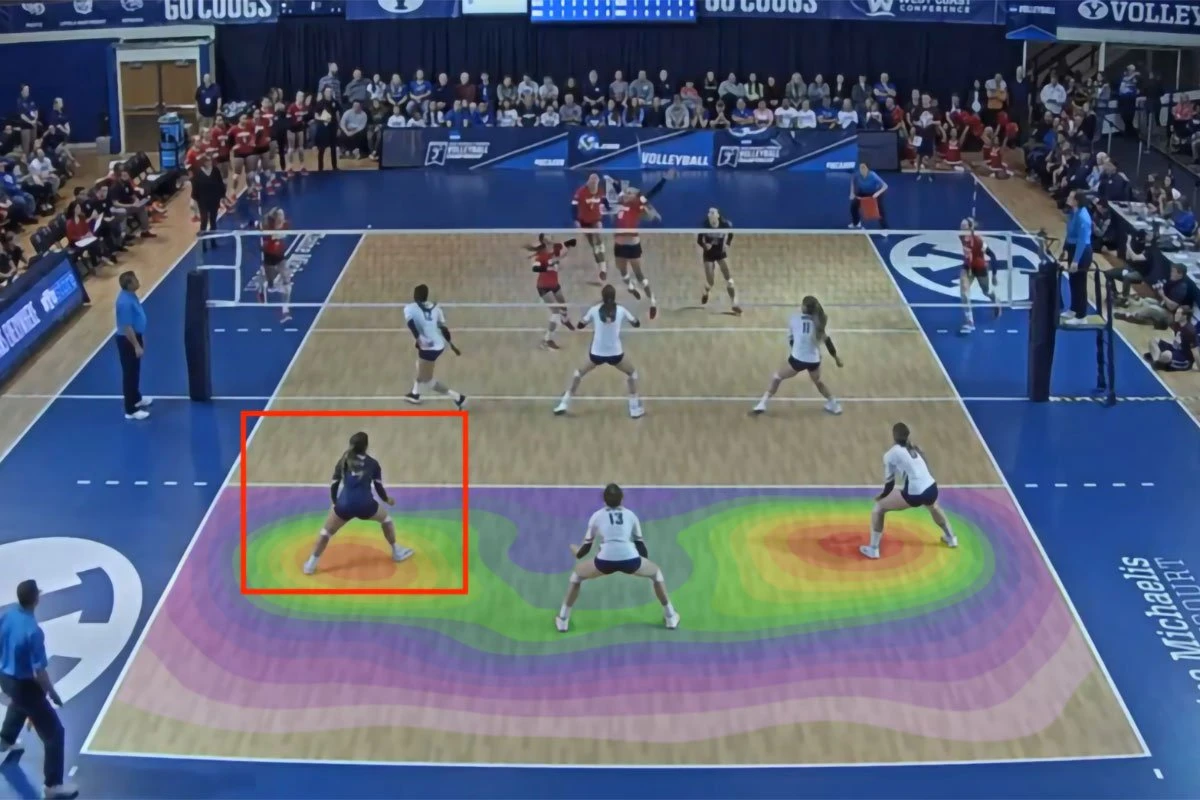
Image Source: Twitter
Under the FIVB's current 2025-2028 rules, the libero may not serve, block or attempt to block. The libero is also restricted from completing an attack hit when, at the moment of contact, the ball is entirely higher than the top of the net.
There is another important restriction involving setting.
If the libero uses an overhand finger pass while in the front zone, a teammate cannot complete an attack on that ball while it is entirely above the net. If the same action is performed from behind the front zone, the teammate can attack normally.
How Does Libero Rotation Work?
The easiest way to think about it is that the team still rotates normally, while the libero replaces back-row players.
The libero does not rotate into the front row. When the player who had been replaced by the libero is due to return to the back row, the libero can leave the court, and that player can return.
This system lets a team keep a defensive specialist on court during the back-row rotations without giving that player front-row responsibilities.
The libero therefore plays a major tactical role even though the position has strict limitations.
Facts About Volleyball Rotation and Libero Rules
- A team has six players on court.
- The three positions near the net are 4, 3 and 2.
- The back-row positions are 5, 6 and 1.
- Rotation moves clockwise when the receiving team wins the rally.
- Position 1 is the serving position.
- The receiving team must be correctly positioned when the serve is hit.
- Players can move freely after the service hit.
- A positional fault occurs when players are incorrectly positioned at service contact.
- A libero can replace players only in back-row positions.
- Only one libero can be on court at a time.
- The libero cannot serve, block or attempt to block under the FIVB rules.
- The libero wears a clearly contrasting uniform.
Why the Libero Does Not Follow Normal Rotation
The libero's unusual movement is deliberate. Volleyball teams need both attacking power and reliable defence, but the strongest attacker is not necessarily the strongest passer or defender.
The libero solves that problem.
A team can use a specialist defender in the back row while maintaining its attacking players for front-row duties. The result is one of volleyball's most distinctive tactical features: players have rotational positions, but their roles can become highly specialised once the serve has been delivered.
That is also why watching a libero can initially seem confusing. The player repeatedly enters and leaves the court while the rest of the team continues through its normal rotation.
FAQ
How many positions are there in volleyball?
There are six court positions in indoor volleyball: 1, 2, 3, 4, 5 and 6. Positions 2, 3 and 4 are the front row, while 1, 6 and 5 are the back row.
Which way do volleyball players rotate?
Players rotate clockwise when their team wins a rally while receiving serve. The player in position 2 moves to position 1 and becomes the server.
Can volleyball players change positions after the serve?
Yes. Once the server has hit the ball, players can move around their own court and free zone. They must, however, be correctly positioned at the moment of service contact.
Can a libero go to the front row?
No. The libero is restricted to back-row play and cannot rotate into the front-row role.
Can the libero attack?
A libero cannot complete an attack hit if, at the moment of contact, the ball is entirely above the top of the net.
Can a libero serve?
Under the FIVB Official Volleyball Rules 2025-2028, a libero may not serve.
What happens if a team is in the wrong rotation?
If a player is not in the correct position when the serve is hit, the team commits a positional fault.
Also Read: What Do Different Basketball Jersey Numbers Mean?