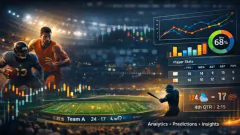
For most of its history, sport relied on instinct. Coaches trusted experience, scouts trusted their eyes, and decisions were justified after the fact.
That model worked when data was scarce and margins were wide. It no longer holds. Modern sport operates under tighter competitive balance, global visibility, and financial pressure that punishes guesswork.
What changed was not the arrival of technology itself, but its role. Data stopped being descriptive and became decision-making infrastructure. Algorithms began influencing tactics, recruitment, load management, and even officiating review.
This transition is visible not only inside clubs and federations, but across adjacent ecosystems – including analytics and wagering environments used by platforms such as qataronlinecasinos.com, where models increasingly assume that teams behave rationally rather than emotionally. Sport did not lose its human element. It learned to think alongside it.
Tactical Decision-Making: From Intuition to Probability
The earliest sign that sports had learned to “think” appeared in tactics. Coaches began replacing intuition-driven choices with probability-weighted decisions, especially in high-leverage moments.
A well-documented example is football (soccer) clubs such as Liverpool FC and Manchester City FC, both of which embedded data science teams into tactical planning.
Decisions around pressing intensity, defensive line height, and substitution timing are now informed by expected goals (xG), expected threat (xT), and player fatigue models rather than gut feel.
How Thinking Systems Changed Tactics
| Decision Area | Traditional Approach | Data-Driven Approach | Practical Effect |
| Shot selection | Visual confidence | xG probability | Better shot quality |
| Pressing | Coach preference | Possession value models | Energy efficiency |
| Substitutions | Intuition / crowd pressure | Fatigue + impact modeling | Late-game control |
| Set pieces | Repetition | Pattern optimization | Higher conversion |
| Defensive shape | Reactive | Spatial occupation models | Reduced exposure |
These changes matter because tactics stopped being reactive. Teams began anticipating outcomes instead of responding to them. Probability replaced hindsight as the dominant logic.
After the table, the deeper shift becomes clear: coaches did not surrender authority to data, they gained a second layer of reasoning – one that sees patterns the human eye cannot track in real time.
Recruitment and Talent Evaluation as Systems Thinking
Nowhere did sports learn to think faster than in recruitment. Traditional scouting relied heavily on subjective assessment and reputation. Data-driven models reframed talent as a portfolio problem: risk, upside, replacement value.
The most cited real-world example is Oakland Athletics in baseball, whose analytics-led recruitment philosophy reshaped the sport. In football, clubs like Brentford FC and FC Midtjylland adopted similar logic – building squads through statistical inefficiencies rather than star chasing.
Thinking Models in Player Recruitment:
- Expected contribution models: Evaluate players on actions leading to outcomes, not raw statistics.
- Age-curve optimization: Project peak performance windows instead of paying for past success.
- Replacement value logic: Assess whether performance can be replicated at lower cost.
- Injury-risk modeling: Use load and medical history to price availability, not just ability.
- Market inefficiency targeting: Focus on leagues and roles undervalued by traditional scouting.
Each mechanism reduces emotional bias. Recruitment becomes capital allocation, not talent worship.
The implication is structural. Clubs that think systemically survive variance. Clubs that chase narrative absorb risk without pricing it correctly. Modern sport increasingly rewards the former.
Performance, Load, and Real-Time Decision Loops
The final stage of sports learning to think occurred at the performance level. Training, recovery, and in-game decisions became feedback loops rather than static plans.
Elite teams now use wearables and AI platforms – such as those deployed by Catapult Sports – to monitor acceleration, deceleration, heart rate variability, and neuromuscular fatigue. These inputs feed models that adjust training load daily, not seasonally.
Real-Time Thinking in Performance Systems
| Input | Data Collected | Decision Enabled |
| GPS wearables | Distance, sprint load | Training intensity |
| Biometric sensors | HRV, recovery | Rest vs play |
| Video analytics | Movement patterns | Tactical tweaks |
| AI forecasting | Injury probability | Squad rotation |
| Live dashboards | Combined metrics | In-game substitution timing |
This table shows why performance management shifted from planning to prediction. Decisions are no longer fixed in advance; they are recalculated continuously.
After the table, the broader consequence appears. Sport learned to think in loops. Action generates data. Data updates models. Models inform action again. This recursive logic is what separates modern sport from its past.
Conclusion
Sports learned to think when data became a decision layer, not a reporting tool. Probability replaced instinct, systems replaced anecdotes, and feedback loops replaced static plans.
The result is not less humanity in sport, but better judgment under pressure. Thinking systems did not remove uncertainty – they taught sport how to live with it intelligently.