You can physically wear soccer cleats for baseball, but they are not the right choice for regular baseball play. Soccer cleats are designed around lateral movement, quick changes of direction and ball control, while baseball cleats are built around the movements of running bases, fielding and pushing off dirt and grass.
The biggest visual difference is easy to spot: soccer cleats do not have a stud at the very front of the toe, while baseball cleats typically do. That extra toe cleat is part of the baseball-specific traction design.
So, if you are heading to a baseball game, buying baseball-specific footwear is the safer and more effective choice.
Soccer Cleats vs Baseball Cleats
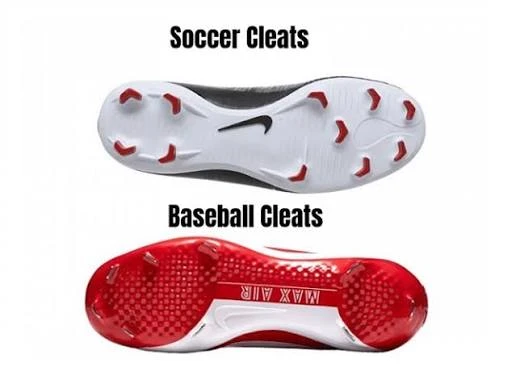
Image Source: Twitter
| Feature | Soccer Cleats | Baseball Cleats |
|---|---|---|
| Main purpose | Soccer movement and ball control | Running, fielding and batting |
| Toe cleat | No | Typically yes |
| Movement focus | Lateral cuts and pivots | Sprinting, pushing off and turning |
| Typical surfaces | Grass and artificial soccer surfaces | Grass, dirt and baseball fields |
| Cleat pattern | Designed for soccer movement | Designed for baseball movement |
| Best choice for baseball | No | Yes |
The difference is not simply cosmetic. Cleat placement changes how the foot interacts with the ground.
Soccer players frequently make rapid lateral movements while dribbling, defending and changing direction. Soccer cleats are therefore designed without a front toe stud, which also helps with ball control and reduces the risk associated with an exposed toe stud during soccer contact.
Baseball asks for something different. A player may explode out of the batter's box, sprint between bases, stop on dirt or make a sudden defensive movement. Baseball cleats are designed to provide traction for those movements.
Why Do Baseball Cleats Have a Toe Cleat?

Image Source: Twitter
The extra toe cleat is one of the quickest ways to distinguish baseball footwear from soccer footwear.
Baseball shoes are designed with cleats positioned to help players dig into grass and dirt when accelerating, stopping and changing direction. The additional toe cleat is a feature intended to provide traction when pushing off for quick movements.
That does not mean every baseball league permits every type of cleat.
The material of the cleat matters too. Baseball footwear can use metal, moulded synthetic or TPU cleats, while turf shoes use a non-cleated outsole designed for artificial surfaces.
Can Soccer Cleats Be Used in a Baseball Game?
There are two separate questions: will they physically work, and are they permitted?
Physically, soccer cleats provide grip and are certainly better than ordinary flat shoes on grass. But they lack the baseball-specific outsole design and toe cleat that help with baseball movements. Baseball cleats are therefore the better choice for baseball rather than soccer cleats.
Rules are a separate issue.
Different baseball organisations can have different footwear requirements. For example, Little League's current rules specify particular requirements for cleats, including restrictions on metal spikes at younger levels. Little League's 2026 rules resources should be checked for the player's specific division.
That means never assume that a pair of soccer cleats is automatically legal simply because it has studs.
What Happens If You Use Soccer Cleats for Baseball?

Image Source: Twitter
The main problem is not that soccer cleats suddenly become dangerous simply because they are soccer cleats. The issue is that they are optimized for a different sport.
Imagine leaving the soccer pitch and stepping onto a baseball diamond. The surface immediately changes the equation. Instead of repeatedly cutting across grass while controlling a ball, you may be accelerating from home plate, running on dirt or planting your foot while turning around a base.
A baseball-specific cleat is designed around those demands.
Soccer cleats can therefore be considered a temporary compromise, not an ideal baseball shoe.
For occasional casual practice, the situation may be different from competitive play, but players should still follow the rules established by their league, school or tournament.
Can Baseball Cleats Be Used for Soccer?
This is not a good swap either.
Baseball cleats commonly include a toe cleat, whereas soccer cleats are deliberately designed without one. A toe stud is generally not appropriate for soccer because of safety and ball-control considerations.
Soccer also places unusual importance on the player's ability to make quick lateral movements and maintain close contact with the ball.
In other words, both sports use cleats, but they do not use them in the same way.
What About Youth Baseball?
This is where checking the exact rules becomes particularly important.
Little League maintains its own official regulations and updates its rulebook for the current season. For 2026, the organisation provides its official rules through its Rulebook App and rules resources.
Little League also states that metal spikes or cleats are not permitted in Majors and below, while higher divisions have different provisions.
So a parent buying footwear for a young baseball player should not simply look at the cleat pattern. The player's division and league rules matter just as much.
If you are wondering, 'Can you wear soccer cleats for baseball?', the practical answer is:
Yes, they can provide traction, but they are not recommended as a substitute for baseball cleats.
Soccer cleats lack the front toe cleat found on typical baseball footwear and are designed for a different movement pattern. Baseball cleats provide sport-specific traction for running, pushing off, fielding and moving across dirt and grass.
For competitive baseball, use baseball-specific cleats that comply with your league's rules.
FAQ
Are soccer cleats and baseball cleats the same?
No. Soccer cleats are designed for soccer's lateral movement and ball control, while baseball cleats are designed for baseball-specific traction and movement.
Why don't soccer cleats have a toe cleat?
Soccer cleats are designed without a front toe stud to support soccer movement and ball control and to avoid the safety concerns associated with a toe stud.
Do baseball cleats have a toe cleat?
Typical baseball cleats do. The toe cleat is part of the baseball-specific traction pattern and helps with pushing off during explosive movements.
Can you wear soccer cleats for baseball practice?
They may provide traction, but baseball-specific cleats are the better option. If the practice is governed by league rules, follow those footwear requirements.
Are metal baseball cleats allowed?
It depends on the competition. Little League, for example, restricts metal cleats in younger divisions while allowing them in certain older divisions. Always check the rules for your specific league and age group.
Which cleats should you buy for baseball?
Buy baseball-specific cleats appropriate for the playing surface and your league's rules. Options include moulded synthetic/TPU cleats, metal cleats where permitted, and turf shoes for appropriate artificial surfaces.
Also Read: Tennis vs Pickleball Court Size: What Is the Difference?