

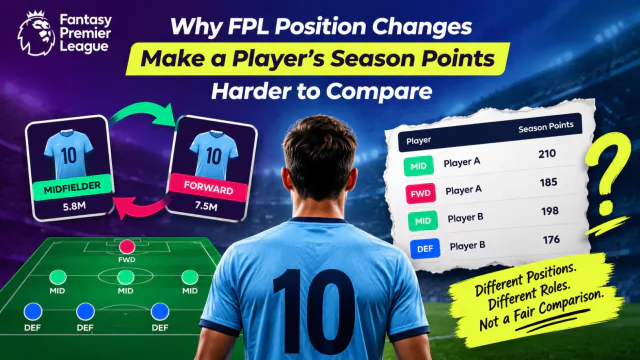
Why FPL Position Changes Make a Player's Season Points Harder to Compare
Fantasy Premier League managers often compare a player's season total with figures from earlier campaigns as if all those points had been calculated on the same basis. But when FPL reclassifies a player between seasons, the same number of goals and qualifying clean sheets can produce a different fantasy return. That makes year-to-year totals harder to interpret without checking the player's listed position.
The official FPL scoring rules explain why. A goal scored by a defender returns 6 points. The same strike from a midfielder is worth 5, and from a forward, just 4. Clean sheets split even more sharply: goalkeepers and defenders both earn 4 points for a clean sheet, while midfielders get just 1. A player must play at least 60 minutes, excluding stoppage time, to earn clean-sheet points. If substituted after reaching that threshold, he retains those points even if his team concedes later.
The Points Gap Nobody Reads the Fine Print On
Move a player from defender to midfielder and he loses 1 point per goal plus 3 points for each qualifying clean sheet. Shift him from midfielder to forward and the goal value drops again, by a single point, though the clean sheet hit is smaller since midfielders only had 1 point to lose in the first place. Defender to forward is the steepest fall: 2 points per goal and the full 4-point clean sheet allowance gone entirely.
The classification alone cannot tell us whether the player has become better or worse at football. Across the football tournaments of this season or earlier, his role on the pitch may change, but FPL assigns a fixed position for each Premier League campaign. A later reclassification does not change points awarded in previous seasons.
The 2026/27 Shuffle
This season's reclassification list reads like a tour of tactical footnotes. Junior Kroupi went from forward to midfielder after mainly playing as a No. 10 behind Evanilson at Bournemouth, a move the Premier League explicitly tied to role rather than fantasy optics. Patrick Dorgu shifted from defender to midfielder because of how Michael Carrick used him through the second half of the previous campaign at Manchester United. Myles Lewis-Skelly, Lamare Bogarde and Keane Lewis-Potter all made the same defender-to-midfielder jump.
Going the other way, Mats Wieffer dropped from midfielder to defender at Brighton, while Georginio Rutter and Omar Marmoush both moved from midfielder to forward, changing the scoring attached to their goals and clean sheets from 2026/27 onwards. Consider Kroupi's 13 Premier League goals in 2025/26: as an FPL forward, those goals were worth 52 points. At the midfielder rate, the same 13 goals would be worth 65 points, a difference of 13 before clean-sheet points. This is an illustrative comparison, not a retroactive change to his recorded 2025/26 total.
It Has Happened Before, and It Can Reverse
FPL's 2020/21 position changes show that this is not new: Michail Antonio moved from midfielder to forward after scoring eight of his ten goals across the final seven gameweeks as West Ham's lone striker. Pierre-Emerick Aubameyang went the opposite direction that same season, from forward to midfielder, having scored 22 goals while playing predominantly on Arsenal's left wing. Richarlison, Anthony Martial and Fernandinho all shifted too, while Marcus Rashford and Mason Greenwood dropped from forward to midfielder.
A year later, Aubameyang swapped back to forward for 2021/22. Allan Saint-Maximin made the same midfielder-to-forward move at Newcastle, with teammate Matt Ritchie going from midfielder to defender. Ainsley Maitland-Niles and Stuart Dallas both moved from defender to midfielder that year as well. A player's FPL position isn't a fixed trait; it tracks where he's actually being used, and it can swing back and forth across consecutive seasons for the same individual.
What the Raw Totals Don't Show
The effect goes beyond goals and clean sheets. FPL also awards two defensive-contribution points when a player meets a position-specific threshold. Defenders need 10 qualifying clearances, blocks, interceptions and tackles in a match; midfielders and forwards need 12 qualifying actions but can also count ball recoveries. Reclassification changes which threshold applies and which squad slot a player occupies. For Marmoush, the switch to forward also means four rather than five points per goal and no midfielder's clean-sheet point.
When a player's FPL total rises or falls between seasons, the change does not by itself prove improved or declining performance. Goals, minutes, assists and qualifying clean sheets may differ, but the scoring attached to them may also have changed with the player's classification. Kroupi's reclassification illustrates the distinction: his future goals can carry a new points value without altering his old total. A fair comparison therefore checks the FPL position used in each season alongside the underlying match statistics, rather than treating raw point totals as a position-neutral measure.











Disclaimer
Possible11 is a sports news and analysis platform designed purely for entertainment and educational purposes. All match previews, player insights, and team analyses are based on publicly available information and expert opinions. We do not promote or support betting, gambling, or real-money gaming in any form. Users are encouraged to enjoy our content responsibly and use it for informational purposes only.











Give Your Feedback