

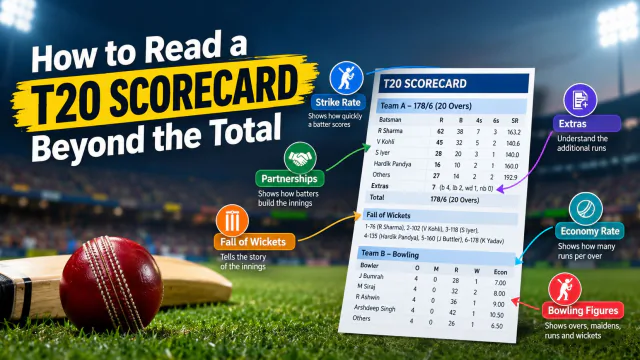
Eighty runs after ten overs tells only part of a T20 story. The wickets lost, the target and the batters at the crease can change what that total means. For supporters following Bangladesh, reading those details together makes a scorecard more useful than reacting to a single number or a confident prediction in a group chat.
When 888bet appears in an online discussion about cricket, the analysis should still begin with identifiable match information. A familiar name does not replace a scorecard, and a prediction is not a result. Understanding the position means asking what has happened, what remains available and which parts of an assessment are still uncertain.
Read the ball count correctly
The notation 12.4 overs means twelve completed overs and four further valid balls. It is not an ordinary decimal. With six valid balls to an over, that represents 76 valid balls. Treating the figure as twelve point four overs produces the wrong denominator when calculating a scoring rate.
In a hypothetical innings, 80 runs after ten overs gives a run rate of eight per over. The same 80 after twelve overs represents a slower rate. Both the total and the number of balls used are necessary for a meaningful comparison. A graphic displaying runs alone cannot explain how quickly an innings has developed.
Extras help explain the sequence too. Under the MCC Laws, a no ball does not count as one of the valid balls of the over. Runs can therefore increase without the displayed valid ball count advancing. Read the delivery record alongside the total when an over appears unusually long or the arithmetic seems confusing.
Separate the current rate from the task ahead
A first innings builds a total; a chase works towards a target. That difference changes which numbers matter most. The current rate describes scoring so far. The required rate describes the remaining task, using the runs still needed and the valid balls left. Neither figure alone provides a complete judgement of the position.
Suppose a side needs 50 runs from five overs. Its required rate is ten per over. That calculation defines the task but cannot guarantee whether it will be completed. Fifty from ten overs is a different challenge, even though the runs required are identical. Time available changes the pressure attached to the number.
Check whether the target itself has changed after an interruption. A post based on an earlier target can remain in circulation after the match situation has moved on. Use a current scorecard and the relevant competition information before repeating a calculation. Correct arithmetic applied to outdated inputs still gives an unhelpful answer.
Put wickets beside the batting order
Seven wickets in hand offers different resources from two, but the count needs context. Identify who is batting and who remains to come. A settled batter, a new arrival and a player with a particular role face different immediate tasks. Familiar names can inform a discussion without making the outcome certain.
Compare runs with balls faced as well. Fifteen from ten deliveries and fifteen from thirty are different contributions to the scoring pace. Even then, the target and events at the other end matter. A batter managing a difficult passage should be assessed against the situation rather than a single isolated statistic.
Watch how a partnership shares the strike. A dot ball may reflect pressure, a missed opportunity or an attempt to manage a particular bowler. A boundary can relieve that pressure without resolving the whole chase. Describing the sequence is usually more useful than treating every delivery as proof that one side now controls the match.
Count the bowling resources still available
The remaining contest includes the bowlers as well as the batters. Check who has overs left and how the captain has distributed the attack. An expensive over does not mean every remaining option presents the same challenge. Saving a particular bowler for later also changes what the batting side will face.
Pitch behaviour, boundary dimensions and fielding can provide further context when they have actually been observed. Keep observation separate from assumption. If you have only read a scorecard, avoid confidently describing movement off the surface or conditions at the ground. Explain the limits of what the available information can support.
Review the reasoning after the match
Choose suitable comparisons. A T20 innings and a Test innings involve different demands, while an opening passage and the final overs present different circumstances. Check current competition conditions before making detailed claims about restrictions. Similar totals do not automatically make two situations equivalent.
Try recording a brief assessment during a break: the runs, balls, wickets and options remaining, followed by your expectation and its reasons. After the finish, review the reasoning as well as the outcome. A correct prediction can rest on weak analysis, while a wrong prediction may still contain useful observations. This habit turns a scorecard into a record of decisions and changing possibilities rather than a promise about what must happen next.











Disclaimer
Possible11 is a sports news and analysis platform designed purely for entertainment and educational purposes. All match previews, player insights, and team analyses are based on publicly available information and expert opinions. We do not promote or support betting, gambling, or real-money gaming in any form. Users are encouraged to enjoy our content responsibly and use it for informational purposes only.










Give Your Feedback