

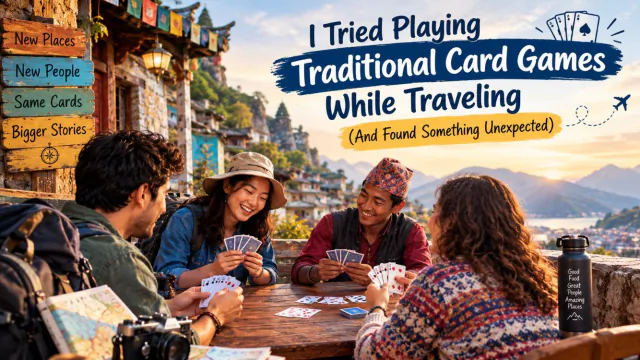
I've been traveling nonstop for the past 18 months. Hotels, airports, long train rides—the whole exhausting routine. Around month 3, I got tired of scrolling through the same apps and streaming services.
So I started looking for something different to fill those random pockets of downtime between flights or after exploring a new city.
I stumbled onto traditional card games from different cultures—not poker or blackjack, but games people actually play in their homes across Asia, Europe, Latin America. Games with rules I'd never heard of and strategies that made my brain work in new ways.
Why Card Games Became My Travel Companion
There's something about learning a game that's been played for 400 years in India or Brazil that connects you to a place differently than just taking photos of monuments. You start understanding how people think, how they socialize, what they value in entertainment.
I spent 11 days in Goa last March. Every evening, locals gathered at a small café near Palolem Beach playing cards for hours, not for big money, just for competition and conversation. I watched for three nights before someone waved me over.
That's when I discovered andar bahar casino game, which became my absolute favorite.
The rules seemed super simple—you bet on one of two sides called Andar or Bahar, dealer places a card face-up, then deals cards alternately to both sides until a matching card appears. Takes maybe 47 seconds per round.
But here's what I love about it. You can play casually while chatting, or you can really study the patterns and probabilities. I've seen people develop all kinds of theories about which side hits more often after certain cards appear.
What Makes Simple Games Actually Interesting
I used to think complex games were better. More rules meant more depth, right?
Wrong.
After playing maybe 200 rounds of various traditional card games across different countries, I changed my mind completely. Simple games let you focus on people instead of rule books. You can teach someone in 90 seconds and they're playing.
When you're traveling, that matters. You meet someone at a hostel, you've got 20 minutes before dinner, you can actually play a few rounds instead of spending the whole time explaining rules.
I learned Scopa in Sicily from a 73-year-old man who spoke exactly 8 words of English. We played for 2 hours using mostly hand gestures and laughter.
The Digital Version Actually Works
I'm usually skeptical about online versions of traditional games. They often feel soulless compared to sitting around a table with real cards and real people.
But some digital platforms actually capture the experience well, especially when you can't physically be in Goa or Sicily. You get the speed and simplicity without needing to carry cards everywhere or find willing players at 2am.
I've played on my phone while waiting for delayed flights in Chicago, during a 4-hour layover in Dubai, and once during a particularly boring business dinner in Austin where I pretended to be checking important emails.
How Games Connect to Travel Culture
Every region has its own card game traditions. After visiting 23 countries, I noticed patterns. Mediterranean cultures tend toward games with lots of card collecting and point counting. Asian games often emphasize prediction and probability in ways that feel almost philosophical. Latin American games mix in more bluffing and social dynamics.
But what really struck me was how these games reflect broader cultural values in ways guidebooks never mention. Countries with strong community traditions have games designed for 4-6 players sitting together for hours. Places with faster-paced cultures have quicker games with rapid rounds.
You can learn more about a place from watching people play cards for one evening than from reading three guidebooks. How they react to winning, how they handle losing, whether they trash-talk or stay quiet, if they play conservatively or take wild risks—all of that tells you something real.
I've started planning some trips around gaming traditions now. Not as the main reason, but as something to explore alongside the usual tourist stuff. Next month I'm spending 9 days in Brazil partly because I want to understand Truco better after playing it badly in Buenos Aires.







Disclaimer
Possible11 is a sports news and analysis platform designed purely for entertainment and educational purposes. All match previews, player insights, and team analyses are based on publicly available information and expert opinions. We do not promote or support betting, gambling, or real-money gaming in any form. Users are encouraged to enjoy our content responsibly and use it for informational purposes only.





Give Your Feedback