
There is no single yellow-card number that automatically causes a suspension in every soccer competition. Yellow-card accumulation rules are set by the competition or governing body, so the threshold can differ between domestic leagues, UEFA competitions and international tournaments.
For example, in the 2026/27 Premier League, a player who receives five yellow cards in their team's first 19 league matches serves a one-match suspension. Ten yellow cards by and including the team's 32nd fixture bring a two-match suspension.
In the UEFA Champions League and Europa League, the system is different. During the relevant competition stages, players are suspended after three accumulated yellow cards and then after subsequent odd-numbered cards, such as the fifth and seventh.
That difference is the key point: yellow cards do not have one universal accumulation limit across soccer.
Yellow Card Suspension Rules: The Key Facts
- A yellow card is a caution; a red card sends a player off.
- A player can receive a suspension for accumulating yellow cards across separate matches.
- The number required depends on the competition's disciplinary regulations.
- A second yellow card in the same match is different from accumulating yellow cards across multiple matches: it results in a red card and the player is sent off.
- Yellow cards can expire or be reset at specific stages of a competition.
- A yellow-card suspension may apply only to the competition in which the cards were accumulated, depending on the regulations.
How Does Yellow Card Accumulation Work?

Image Source: Twitter
A yellow card during a match does not normally mean the player misses the next game.
The immediate purpose of the yellow card is to caution the player for a cautionable offence. The accumulation system is a separate disciplinary mechanism that tracks cautions over a defined period or competition.
Once a player reaches the competition's specified threshold, the disciplinary regulations can trigger an automatic suspension.
The important detail is that the threshold may also come with a cut-off date or match limit.
How Many Yellow Cards Lead to a Premier League Suspension?
The 2026/27 Premier League provides a straightforward example.
A player who accumulates five yellow cards in the first 19 Premier League matches of the season receives a one-match suspension in the same competition.
A player reaching 10 yellow cards by and including their team's 32nd Premier League fixture receives a two-match suspension.
The Football Association's player guidance also explains that accumulated yellow cards in league matches can produce automatic sanctions at five, 10, 15 and 20 cautions, subject to the relevant competition and cut-off rules.
This is why simply saying "five yellow cards equals a suspension" is incomplete. The number of cards and the point in the season at which they are received both matter.
How Many Yellow Cards Cause a UEFA Match Ban?
UEFA competitions use their own accumulation system.
Under the 2026/27 UEFA Champions League regulations, before the league phase, a player is suspended for the next competition match after three yellow cards that did not result in a red card. Further suspensions follow after subsequent odd-numbered yellow cards, including the fifth and seventh.
The 2026/27 Europa League regulations use the same basic three-card, then odd-numbered-card approach before the league phase.
UEFA also has rules that can reduce the accumulation count at specified points during a competition. This prevents a player from simply carrying every yellow card indefinitely through the tournament.
So a player who has been booked twice in one competition should not automatically assume that the next yellow card will have the same consequences as it would in the Premier League.
Two Yellow Cards in One Match vs Yellow Card Accumulation
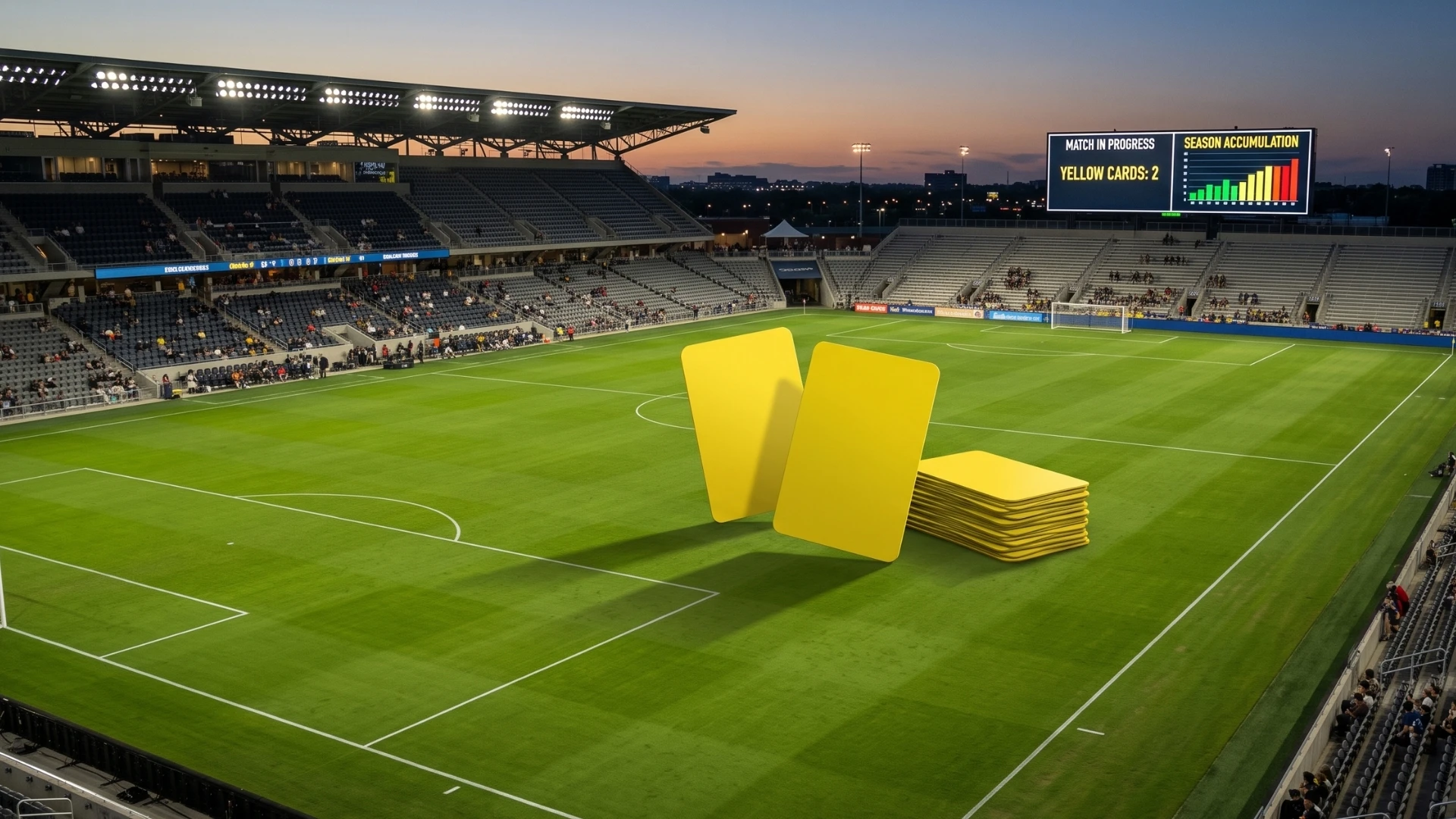
These two situations are often confused.
Yellow-card accumulation happens when a player collects cautions across multiple matches and eventually reaches the competition's suspension threshold.
A second yellow card in the same match is an on-field disciplinary event. The player receives the second caution, followed by a red card, and is sent off.
That player cannot simply remain on the pitch because the two cards are "only yellow cards." The second caution produces a sending-off.
The resulting suspension is then governed by the relevant competition's disciplinary regulations.
What Happens After a Red Card?
A red card is not the same as reaching a yellow-card accumulation threshold.
Under UEFA's 2026/27 club competition regulations, a player sent off is automatically suspended for the next match in a UEFA club competition. UEFA's disciplinary bodies can increase the punishment for a serious offence.
The length and scope of a red-card suspension can therefore depend on the reason for the dismissal and the competition's disciplinary rules.
This distinction matters when checking whether a player will miss the next match. Looking only at their yellow-card total is not enough if they have also been sent off.
Do Yellow Cards Carry Over Between Competitions?
Usually, you should not assume that they do.
The Premier League states that yellow cards accumulated in Premier League matches are not carried over to the EFL Cup or FA Cup. Red-card suspensions operate differently and can carry across domestic competitions under the applicable rules.
This means a player cannot necessarily take a domestic league yellow-card total and add it to cards received in another tournament.
The competition's regulations determine which cards are counted and where any resulting suspension must be served.
When Are Yellow Cards Wiped Out?
Yes, in some competitions, yellow-card totals are cleared at specific stages.
The 2026 FIFA World Cup, for example, introduced a specific reset arrangement for the expanded tournament. Individual yellow cards in the final competition are cancelled after the group stage and again after the quarter-finals. FIFA said the change was designed so players would not miss the final because of yellow-card accumulation from earlier knockout rounds, while a semifinal sending-off could still affect the final.
UEFA competitions also have their own expiry provisions. For example, the 2026/27 UEFA Youth League regulations state that yellow cards expire after the quarter-finals and are not carried into the semi-finals.
Therefore, a player's total can sometimes return to zero without the player having served a suspension.
Why Yellow Card Rules Differ Between Soccer Competitions

The biggest mistake when answering "How many yellow cards lead to suspension?" is treating soccer as if it has one worldwide disciplinary table.
The IFAB Laws of the Game establish the fundamental laws governing yellow and red cards, but competition-specific disciplinary regulations determine how accumulated cautions lead to suspensions. IFAB itself notes that the same Laws apply across competitions, while permitted competition modifications and disciplinary frameworks can affect how competitions operate.
That is why the answer can be five cards in one competition, three in another, or a different number altogether.
Can Yellow Card Rules Change During a Tournament?
Even within the same governing body, different competitions can have different accumulation systems.
For example, UEFA's 2026/27 Nations League regulations state that players are suspended after two yellow cards during the league phase and after subsequent even-numbered yellow cards, such as the fourth and sixth.
That is different from the UEFA club competition system based on three, five, seven and so on.
The lesson for players, coaches and fans is simple: always check the disciplinary regulations for the specific competition.
What Should You Check Before a Player Faces a Suspension?
If a player is close to a suspension, four details are particularly important:
- Competition: Is it a domestic league, cup, UEFA tournament or international competition?
- Yellow-card total: How many accumulated cautions does the player have?
- Cut-off or reset: Is there a match limit or tournament stage after which cards expire?
- Suspension scope: Where must the resulting ban be served?
These details can completely change whether a player is available for the next match.
FAQ
How Many Yellow Cards Lead to a Soccer Suspension?
There is no universal number. The threshold depends on the competition. In the 2026/27 Premier League, five yellow cards within the first 19 league matches trigger a one-match suspension, while UEFA competitions can use different thresholds.
Does One Yellow Card Mean a Player Misses the Next Game?
Usually, no. A single yellow card is normally a caution. A suspension can occur when accumulated yellow cards reach the threshold established by the competition.
Do Two Yellow Cards in One Game Equal a Red Card?
Yes. A player who receives a second caution in the same match is shown a red card and sent off.
Are Yellow Cards Counted Across Different Competitions?
Not necessarily. Competition regulations determine how cards are counted. For example, Premier League yellow cards are not carried over to the EFL Cup or FA Cup.
Can Yellow Cards Be Cancelled During a Tournament?
Yes. Some competitions reset or cancel accumulated yellow cards at specified stages. The 2026 FIFA World Cup, for example, cancels individual yellow cards after the group stage and again after the quarter-finals.
Is a Yellow Card Suspension the Same as a Red Card Suspension?
No. Yellow-card accumulation and sending-off are separate disciplinary mechanisms. A red card can produce an automatic suspension, with the final length and scope depending on the applicable competition rules.
What Is the Simplest Answer to How Many Yellow Cards Cause a Ban?
It depends on the competition. There is no worldwide soccer rule saying that a fixed number of yellow cards always equals a suspension. Checking the specific tournament's disciplinary regulations is the reliable way to determine when a player will be banned.
Also Read: How Does Offside Work in Soccer?