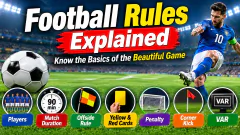
Football Rules Explained: Football is one of the most popular sports in the world, with millions of fans across various countries. From the FIFA World Cup and the UEFA Champions League to domestic leagues, people of all ages enjoy watching football. However, to truly appreciate the sport, it is essential to understand its rules.
Football—referred to as 'soccer' in some countries—is played between two teams. The objective for each team is to score more goals than their opponent. The game is played according to the official rules established by the International Football Association Board (IFAB), which are known as the 'Laws of the Game'.
1. How Many Players Are There in a Football Team?
A standard football match is played between two teams, with each team allowed a maximum of 11 players on the field, including one goalkeeper.
Therefore, a total of 22 players can participate on the pitch at the beginning of a match. A team must have at least seven players to continue a match under the Laws of the Game.
Players generally have different responsibilities depending on their positions:
- Goalkeeper: Protects the goal and prevents the opposition from scoring.
- Defenders: Stop opposition attacks and protect their team's goal.
- Midfielders: Connect defence and attack while controlling possession.
- Forwards: Create scoring opportunities and score goals.
2. How Long Is a Football Match?
A standard professional football match lasts 90 minutes, divided into two halves of 45 minutes each.
- First Half: 45 minutes.
- Half-Time Break: Usually 15 minutes.
- Second Half: 45 minutes.
- Stoppage Time: Additional time awarded by the referee for delays during each half.
If a match is part of a knockout competition and the score is level after 90 minutes, extra time may be played depending on the competition rules.
3. What is the offside rule in football?
The offside rule is one of the most important rules in football, and it can sometimes be quite confusing. A player is considered to be in an 'offside position' when they receive the ball from a teammate and any part of their head, body, or feet is in the opposing team's half, and is closer to the opposing team's goal line than both the ball and the second-last opponent.
However, merely being in an offside position is not an offense in itself. A player must be actively involved in the play—such as by interfering with play, obstructing an opponent, or gaining an advantage from that position.
Important: A player cannot be offside if they receive the ball directly from a goal kick, a throw-in, or a corner kick.
4. What Are Fouls in Football?
A foul occurs when a player commits an unfair or illegal action against an opponent. The referee decides whether a foul has taken place and awards the appropriate punishment.
Some common football fouls include:
- Kicking or attempting to kick an opponent.
- Pushing or holding an opponent.
- Tripping an opponent.
- Deliberately handling the ball (with exceptions for the goalkeeper inside their own penalty area).
- Charging an opponent unfairly.
- Jumping at an opponent in an unfair manner.
Depending on the situation, the referee may award a direct free kick, an indirect free kick, or a penalty kick.
5. What is a penalty kick?
A penalty kick is awarded when a player commits a foul—for which a direct free kick would otherwise be given—inside their own penalty area during the course of a match.
A penalty kick is taken from the penalty spot, located 11 meters (12 yards) from the goal line. During a penalty kick, only the goalkeeper is permitted to attempt to save the goal; all other players must remain outside the penalty area and stand in their designated positions according to the rules.
In some knockout competitions, if a match remains a draw even after the designated extra time, penalty kicks are used to determine the winner.
6. What are yellow and red cards in football?
Referees use yellow and red cards to penalize players for misconduct or serious offenses.
Yellow Card
A yellow card serves as a warning, issued to a player for actions such as unsporting behavior, dissent, repeated fouls, or delaying the restart of play.
If a player receives two yellow cards in the same match, they are shown a red card and sent off the field.
Red Card
A red card means the player must leave the field immediately, and no substitute is permitted to take their place. Common reasons for a red card include serious fouls, violent conduct, denying an obvious goal-scoring opportunity through certain offenses, and other forms of serious misconduct.
7. What is a free kick in football?
A free kick is awarded when a player commits a foul or breaks any other rule. There are primarily two types of free kicks:
- Direct free kick: A goal can be scored directly against the opposing team from this kick.
- Indirect free kick: The ball must touch another player before a goal can be scored.
The referee signals an indirect free kick by raising one arm above their head. This signal remains in place until the kick has been taken and the ball has either touched another player or gone out of play.
8. What is a corner kick?
A corner kick is awarded when the ball, having last been touched by a player from the defending team, crosses the goal line—without a goal being scored.
The attacking team takes this kick from the nearest corner area. It is possible to score a goal directly from a corner kick.
9. What is a goal kick?
A goal kick is awarded when the ball, having last been touched by a player from the attacking team, crosses the goal line—without a goal being scored.
The defending team may take the goal kick from anywhere within the goal area. The ball is considered in play once it has been kicked and clearly moves forward.
10. What is a throw-in?
A throw-in is awarded when the ball completely crosses the touchline (whether on the ground or in the air). The team that did not touch the ball last is awarded the throw-in.
A player taking a throw-in must follow these basic rules:
- Face the field of play.
- Have part of both feet on or outside the touchline, touching the ground.
- Use both hands to throw the ball from behind the head.
- Release the ball from the exact point where it crossed the touchline.
A goal cannot be scored directly from a throw-in.
11. What is 'extra time' in football?
In some knockout matches, if the scores are level after the regulation 90 minutes of play, 'extra time' is played.
Extra time typically consists of two 15-minute halves, giving the teams an additional 30 minutes to score a winning goal.
If the scores remain level even after extra time, the winner may be decided via a penalty shootout, depending on the rules of the competition.
12. What is VAR in football?
VAR stands for 'Video Assistant Referee'. It is a technology-based system that assists the referee and other match officials in reviewing key decisions during a football match.
VAR can intervene primarily in the following four situations:
- Goals and any errors or fouls leading up to a goal.
- Decisions related to penalties.
- Incidents involving direct red cards.
- Cases of 'mistaken identity', where a referee might accidentally penalize the wrong player.
The final decision always rests with the referee. They can review footage on a monitor placed on the sidelines or make a decision based on information provided by the VAR team.
13. How is the winner determined in football?
The team that scores more goals than its opponent during the match is declared the winner. If both teams score an equal number of goals, the match is considered a 'draw' in most league competitions.
In knockout competitions, if the score remains level, the winner may be decided through extra time and a penalty shootout.