

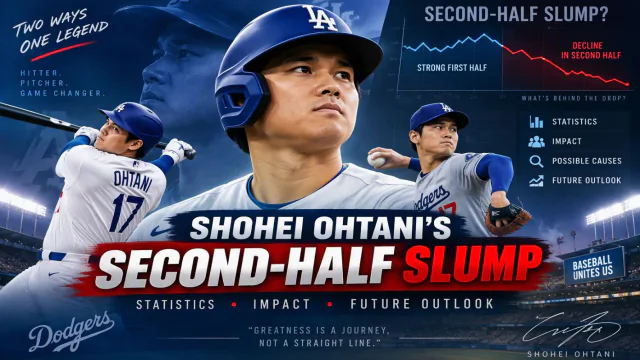
In 2026, Shohei Ohtani played a central role for the Los Angeles Dodgers throughout the season; he made his presence felt as both a hitter and a pitcher throughout the regular season, but his batting performance showed a significant drop around mid-August, and he fell into a prolonged slump. The shift in his numbers was clear and had a huge impact on the team’s fortunes. Eventually this year will surely be remembered as a major turning point in his career.
The Big Picture of the Regular Season and the Start of the Slump
For the regular season as a whole, he posted a .275 batting average, 30 home runs, 81 RBIs, and an OPS of .889. As a pitcher, he made 14 starts, posting a record of 8 wins and 2 losses with a 1.79 ERA, demonstrating consistent performance. From the first half through the middle of the season, he produced a steady stream of extra-base hits and served as a pillar of the top of the lineup. His power at the plate remained intact, and expectations from fans and team officials were high.
However, after hitting his last home run on August 18, he went approximately 25 games—spanning around 116 at-bats—without hitting another home run. During this period, his batting average plummeted to around .156, and his extra-base hits became extremely scarce. This was one of the longest slumps of his career, and the sharp decline in his numbers was not merely a temporary blip but came to be remembered as a clear turning point. As the season drew to a close, concerns began to spread and became a reality.
Changes in Physical Condition and Mechanics Behind the Slump
Underlying his slump were physical issues with his right biceps and left knee. He stopped pitching after July 3 and was placed on the injured list in September, taking about two weeks off. After returning, he focused solely on hitting, but his batting performance did not recover. It is highly likely that his physical condition not being at its best directly affected his results.
Statistically, there was a noticeable trend of him being off-timing, particularly against fastballs exceeding 95 mph, which led to a decline in the quality of his hits. Ohtani himself explained that his inability to hit was not due to symptoms but was within the range of his capabilities, and he pointed out issues with his mechanics and timing. The fact that he did not use his injury as a direct excuse and demonstrated a commitment to improvement is characteristic of his personality. Testimonies from those close to him suggest that he went through a process of trial and error as he worked to adjust.
Postseason Performance and Impact on the Team
His slump continued into the postseason. His batting average hovered around .192, particularly during the NLCS, and he went a long time without hitting a home run. He finally hit a three-run homer in Game 4—his first in about two months—but the Dodgers were swept 4-0 by the Milwaukee Brewers in the series. The impact of a batter who should have been the offensive anchor failing to perform was greater than the numbers alone suggest.
Ohtani’s slump was clearly reflected in bookmakers’ championship predictions, and concern is spreading among avid fans in his home country who follow the Japanese bookmakers offering odds on MLB. Amid the Dodgers’ overall offensive struggles, his decline in production had a particularly significant impact and was a contributing factor to their early elimination. It was a series that clearly highlighted the gap between the team’s expectations and reality.
The Severity of the Slump: A Fantasy Baseball Perspective and the Data
The decline in OPS and slugging percentage during the second half of the season directly impacted a player’s value in fantasy baseball. These players came to be seen as prime examples of difficult picks, leading to more situations where fantasy managers had to make tough decisions in the midst of the race for the standings. The changes in their numbers were not merely a matter of perception but could be confirmed as concrete metrics.
Their deteriorating ability to handle fastballs was reflected in the data and aligned with visual observations. This was the result of a combination of accumulated injuries and a misalignment in his swing—a situation so serious that it could not be explained by simple fluctuations in form. It can be said that the numbers confirmed the unease that those close to him had been feeling.
Outlook for Next Season and the Possibility of a Return to the Two-Way Role
Ohtani has made it clear that he intends to make a full return to his two-way role in 2027. Reflecting on this season, he acknowledged that he had few lessons to draw from and plans to focus on off-season conditioning. His own words reveal a sincere commitment to addressing the challenges he faced this season.
Given that he is 32 years old, managing his physical condition will be more important than ever. The key to his comeback lies in whether he can regain his timing at the plate while preventing a recurrence of his injuries. While his positive attitude is reassuring, this will likely be a year that requires a realistic recovery process. How he applies the lessons learned throughout the season will determine how he is evaluated moving forward.








Disclaimer
Possible11 is a sports news and analysis platform designed purely for entertainment and educational purposes. All match previews, player insights, and team analyses are based on publicly available information and expert opinions. We do not promote or support betting, gambling, or real-money gaming in any form. Users are encouraged to enjoy our content responsibly and use it for informational purposes only.







Give Your Feedback