

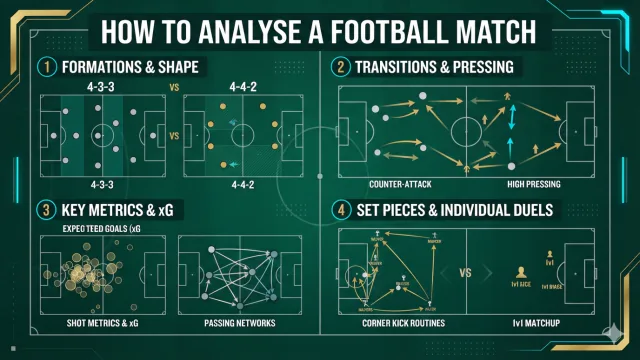
You open your favourite football app, check the next set of fixtures and spot an interesting match. One team is near the top of the league, the other sits comfortably in mid-table. Easy prediction, right?
hrNot necessarily.
The higher-ranked side may have played three exhausting matches in eight days. Its leading striker could be injured, while the supposedly weaker opponent has quietly won four of its last five home games.
This is why football match analysis matters. A league position or a famous club badge rarely tells the whole story.
Whether you're following the Premier League, Indian Super League or another competition, a structured approach can help you understand upcoming matches and make more informed fantasy football decisions.
Here's a practical seven-step method you can use before kick-off.
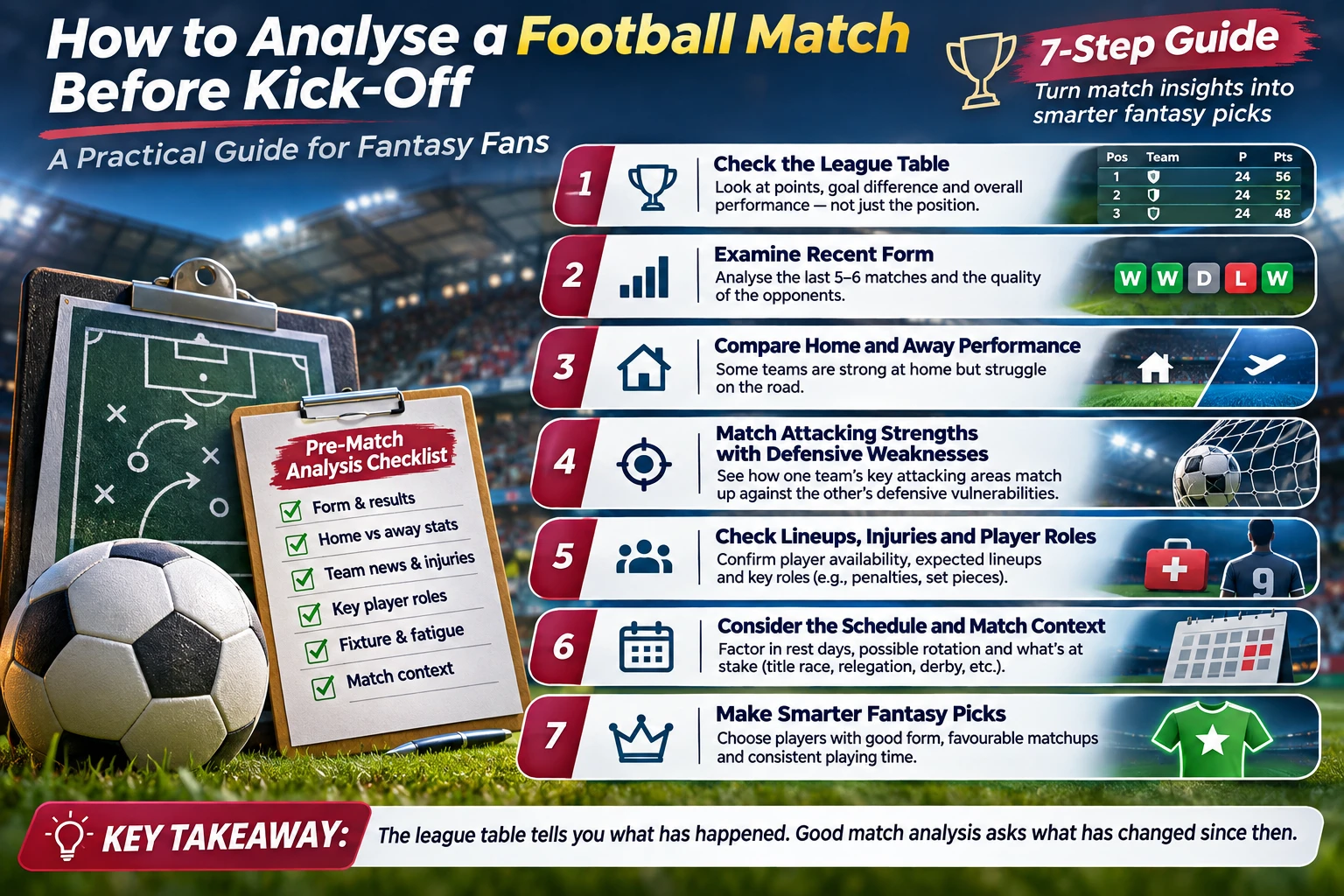
1. Start With the League Table, but Look Beyond the Position
League standings offer a useful first impression of a team's season.
They show how consistently a club has collected points, how many matches it has won and whether it has generally outscored its opponents.
However, two teams sitting next to each other in the table can have very different strengths.
Consider these indicators:
- Points: A measure of results accumulated throughout the season.
- Goal difference: The difference between goals scored and conceded.
- Goals for: A basic indicator of attacking output.
- Goals against: A starting point for evaluating defensive performance.
- Recent form: A quick overview of the team's latest results.
Imagine two clubs with 25 points each. One has scored 30 goals but conceded 28, while the other has scored 20 and conceded just 12.
Both teams have earned the same number of points, but their playing styles and potential fantasy opportunities may differ considerably.
For a practical example, see the data in Match XI's historical Premier League standings, which include points, goal difference and recent-form information.
Remember that a league table describes previous results. It cannot automatically account for injuries, tactical changes or the difficulty of upcoming opponents.
2. Examine Recent Form — and the Teams Behind the Results
A team winning four consecutive matches looks impressive on paper.
But who were those victories against?
Beating four struggling clubs is different from earning the same results against title contenders.
When conducting football match analysis, examine the last five or six competitive fixtures and ask:
- Did the team face strong or relatively weak opponents?
- Were the victories convincing or decided by a single moment?
- Has the team been creating quality scoring chances?
- Has its defence improved or become less reliable?
- Have the same players consistently influenced matches?
Suppose a striker has scored in three consecutive games. Before selecting him for your fantasy team, look at his minutes played, shot volume, penalty responsibilities and the quality of the opposition.
Three goals from three isolated chances tell a different story from three goals produced through constant attacking involvement.
The objective is not to dismiss recent form. It is to understand what caused it.
3. Separate Home and Away Performance
Some teams look almost unstoppable in their own stadium but struggle to reproduce those performances away from home.
Others maintain a relatively consistent style regardless of the venue.
That's why home and away statistics should be examined separately.
For example, a side might average two goals per home match but considerably fewer on its travels.
This distinction can influence fantasy choices, particularly when considering attacking players or defenders with clean-sheet potential.
Look for patterns involving:
- Home and away goals scored.
- Clean sheets at each venue.
- Shots and chances created.
- Defensive errors under pressure.
- Tactical changes when playing stronger opponents.
However, avoid reaching conclusions from tiny samples. Two poor away performances do not necessarily establish a long-term weakness.
4. Compare Attacking Strength With Defensive Vulnerabilities
This is where football match prediction becomes more interesting.
Instead of simply asking which team is stronger, consider how one team's attacking strengths match up against the other team's defensive weaknesses.
A side with dangerous wingers might find opportunities against opponents whose full-backs frequently push forward.
Similarly, a team that relies heavily on crosses may struggle against opponents with strong aerial defenders.
Statistics can provide additional context.
|
Metric |
What it tells you |
Fantasy football relevance |
|---|---|---|
|
Goals scored |
Actual attacking output |
Helps identify productive attacks |
|
Expected goals (xG) |
Estimated quality of scoring chances |
Adds context beyond recent goals |
|
Shots inside the box |
Frequency of dangerous shooting opportunities |
Useful for assessing attacking involvement |
|
Goals conceded |
Defensive results |
Helps evaluate opposing attackers |
|
Expected goals against (xGA) |
Estimated quality of chances allowed |
Helps assess defensive vulnerability |
|
Clean sheets |
Matches without conceding |
Relevant to goalkeeper and defender selection |
No single statistic is enough.
A team can dominate possession without creating clear chances. Another may defend deep, control space effectively and attack through quick transitions.
The best analysis combines statistical patterns with an understanding of how the teams actually play.
5. Check Starting Lineups, Injuries and Player Roles
Imagine spending an entire evening researching a talented forward, only to discover that he has been named among the substitutes.
Fantasy football managers know that uncomfortable feeling.
Player availability is one of the most important parts of pre-match research.
Before finalising your selections, check:
- Injuries and suspensions: Is the player available for selection?
- Expected starting lineup: Is he likely to start or enter from the bench?
- Recent playing time: Has he regularly completed 80–90 minutes?
- Tactical role: Is he playing centrally, out wide or deeper than usual?
- Set-piece responsibility: Does he take penalties, free kicks or corners?
A midfielder playing in an advanced attacking role may offer more scoring opportunities than another midfielder with similar season statistics who plays primarily in defence.
Likewise, a striker returning from injury may be available but not ready to play a full match.
Predicted lineups are useful for early preparation, but they are not confirmation. Always check official team announcements when available, usually around an hour before kick-off.
6. Consider the Schedule, Fatigue and Match Context
Footballers are not machines.
A club competing in domestic league matches, European competitions and cup fixtures may have very little recovery time between games.
That can influence player selection, pressing intensity and the likelihood of rotation.
Before an upcoming fixture, consider three questions.
How much rest has each team had?
A team playing its third match in seven days may approach the game differently from one that has enjoyed a full week of preparation.
Could the manager rotate the squad?
Managers sometimes rest important players before major cup fixtures or after periods of heavy physical demand.
What is at stake?
A relegation battle, title race or important derby can change how teams approach a match.
However, motivation alone should never determine your prediction. A highly motivated side can still struggle against a tactically superior opponent.
The league table tells you what has happened. Good match analysis asks what has changed since then.
7. Turn Your Research Into Smarter Fantasy Football Picks
Once you've examined the teams, the next challenge is turning that information into player selections.
The temptation is to choose the biggest names. Yet a famous player with a difficult fixture and uncertain playing time may offer less value than a less celebrated player with an excellent matchup.
Start by identifying players who combine several positive indicators.
For attackers, look for regular minutes, involvement in scoring opportunities and favourable opposition weaknesses.
For defenders and goalkeepers, assess the team's defensive organisation, the opponent's attacking quality and the chances of a clean sheet.
For midfielders, consider their actual role rather than relying solely on the position assigned by the fantasy platform.
Balance consistency and upside
Some fantasy players offer relatively predictable involvement. Others depend heavily on goals or assists.
A balanced selection should account for both.
Remember that scoring systems vary across fantasy platforms. Some award points for tackles, interceptions or other defensive contributions, while others place greater emphasis on goals, assists and clean sheets.
Always check the rules of the competition you're playing.
A Simple Pre-Match Research Checklist
Before making your final fantasy selections, work through the following questions:
- Is the player expected to start?
- Has he played regularly in recent fixtures?
- Does his role provide opportunities to earn fantasy points?
- Is the opposition particularly strong or weak in the relevant area?
- Has the team had sufficient recovery time?
- Are there injuries or tactical changes that could affect his performance?
If several answers remain uncertain, treat that player as a riskier selection rather than assuming everything will go according to plan.
A Practical Example: When the Favourite May Not Be the Best Fantasy Choice
Let's imagine a fictional match between Blue City and Riverside United.
Blue City sits second in the league, while Riverside United is ninth.
At first glance, Blue City appears to be the obvious favourite.
But a closer examination reveals some interesting details.
Blue City has won only one of its last four away matches. Its first-choice striker is recovering from a minor injury, and the club recently played an exhausting midweek cup fixture.
Riverside United, meanwhile, has won three consecutive home games. Its attacking midfielder has been involved in several goals, and the team has consistently created chances from counterattacks.
What should a fantasy manager conclude?
Not that Riverside United will definitely win.
Instead, the analysis suggests several possibilities:
- Blue City's attacking players may be less attractive than their season totals initially suggest.
- Riverside United's attacking midfielder could benefit from space during counterattacks.
- Blue City's starting lineup requires careful checking because of possible rotation.
- Defensive selections from either team deserve further scrutiny.
This illustrates an important principle: football match analysis is about identifying useful possibilities, not predicting the future with certainty.
You may ultimately select several Blue City players. The difference is that your decision will be based on evidence rather than reputation.
Common Football Match Analysis Mistakes
Even experienced football fans can fall into familiar traps.
Trusting recent results without context
A five-match winning streak looks impressive, but the quality of the opposition and the underlying performances matter.
Assuming more possession means better football
A team with 65% possession may still create fewer dangerous chances than an opponent relying on counterattacks.
Ignoring confirmed lineups
An excellent statistical argument becomes much less useful when the player you're considering starts on the bench.
Relying too heavily on head-to-head records
A match played two seasons ago may have little relevance when both teams have new managers and different squads.
Treating predictions as guarantees
Football contains randomness. Refereeing decisions, red cards, individual mistakes and unexpected tactical changes can overturn even a well-researched expectation.
The goal is to make more informed assessments, not eliminate uncertainty.
How to Complete a Quick Football Match Analysis
You don't need an entire afternoon to prepare for every fixture.
A simple routine can help you organise your research efficiently.
First three minutes: Review league position, recent form, goal difference and upcoming fixtures.
Next three minutes: Compare attacking and defensive statistics, paying particular attention to home and away performances.
Next two minutes: Check injury reports, likely starting lineups and important tactical matchups.
Final two minutes: Identify the most promising fantasy players and note any unanswered questions.
This preliminary routine takes approximately ten minutes.
Before the match begins, return to your selections and verify the official starting lineups. A few late changes can make a significant difference.
Final Thoughts
Football is full of surprises. That's part of what makes following the sport so enjoyable.
Yet surprises shouldn't prevent fans from asking better questions.
Successful football match analysis starts with basic information and gradually builds a clearer picture through recent form, team statistics, tactical matchups, player availability and fixture congestion.
For fantasy football enthusiasts, the real advantage is developing a repeatable decision-making process rather than chasing yesterday's best-performing player.
Start with one upcoming match. Compare both teams, examine the likely lineups and write down the reasons behind your choices.
Then revisit your analysis after the final whistle.
Over time, you'll become better at recognising which indicators are genuinely useful, which signals can be misleading and how to approach the next match with a clearer understanding of the game.










Disclaimer
Possible11 is a sports news and analysis platform designed purely for entertainment and educational purposes. All match previews, player insights, and team analyses are based on publicly available information and expert opinions. We do not promote or support betting, gambling, or real-money gaming in any form. Users are encouraged to enjoy our content responsibly and use it for informational purposes only.










Give Your Feedback