

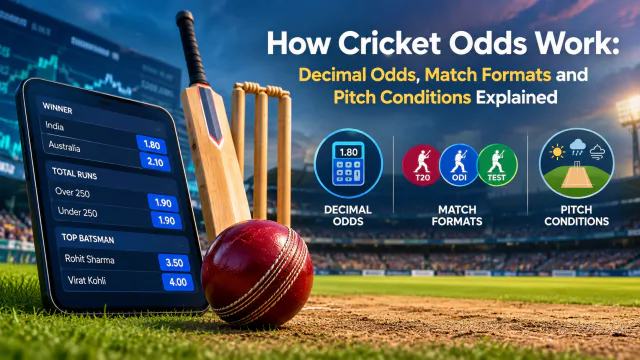
If you have followed cricket coverage online, you have probably seen numbers like 1.80 or 2.40 next to team names before a big match. For many fans these figures look confusing at first, but they are simply a way of expressing how likely an outcome is thought to be. Once you understand the basics, you can read them the same way you read a scorecard, and they also tell you a lot about how experts view a contest. This article explains decimal odds in plain terms and then looks at how match format, pitch, weather, toss and dew push those numbers up and down.
What Are Decimal Odds?
Decimal odds are the most common format used in India and much of the world. The number shows the total amount returned for every one unit staked, including the original stake. So if a team is priced at 1.80, a ₹100 stake would return ₹180 in total if that outcome happens — your ₹100 back plus ₹80 profit. If the price is 3.00, the same ₹100 would return ₹300 in total.
The key point is that a lower number means the outcome is considered more likely, and a higher number means it is considered less likely. A side at 1.30 is a strong favourite, while a side at 4.50 is an outsider. When two evenly matched teams meet, you will often see both priced somewhere around 1.90 to 2.00.
Implied Probability: Turning Odds into Percentages
Every decimal price hides a percentage inside it. To find it, divide 1 by the odds. This is called implied probability.
- Odds of 2.00 → 1 ÷ 2.00 = 0.50, or 50%
- Odds of 1.80 → 1 ÷ 1.80 ≈ 0.556, or about 55.6%
- Odds of 4.00 → 1 ÷ 4.00 = 0.25, or 25%
Take a hypothetical match where Team A is priced at 1.60 and Team B at 2.40. Team A's implied probability is about 62.5% and Team B's is about 41.7%. Add them together and you get roughly 104%, not 100%. That extra few percent is the bookmaker's margin, sometimes called the "overround". It is built into almost every market, which is why the implied probabilities of all outcomes usually add up to slightly more than 100%. Knowing this helps you see that odds are not a pure prediction; they also include a commercial cushion.
If you want a broader walkthrough of the common terms and market types, this beginner's guide covers the vocabulary in more detail. For now, let us look at what actually makes these numbers move.
How Match Format Changes the Picture
Cricket is unusual because the same two teams can play three very different formats, and each one behaves differently.
Test cricket. A Test is played over up to five days, and a draw is a genuine possible result. That means a Test market typically has three outcomes instead of two. Because the game is long, odds tend to shift gradually session by session. A strong first-innings total, a collapse after lunch or a rain-affected day can all change the picture, but there is usually time for the game to swing back. As a match heads into the final day, the draw price often becomes very important, especially on flat pitches where taking twenty wickets is difficult.
ODIs. A 50-over game sits in the middle. There is enough time for a team to recover from a poor start, but not as much as in a Test. Prices usually react sharply to early wickets in a chase or to a big partnership in the middle overs, and then settle into a clearer trend in the last 15 overs.
T20s. The shortest format is also the most volatile. Just one over going for 20 runs, or two quick wickets in the powerplay, can flip a match. That is why live prices in T20 cricket, including franchise leagues like the IPL, can swing dramatically within a few balls. Pre-match, T20 favourites are often priced less heavily than ODI or Test favourites, because the format gives the weaker side a better chance of an upset.
Pitch Conditions and Indian Venues
The surface is one of the biggest factors in any cricket match, and Indian grounds offer a lot of variety.
Some venues are known for being batting-friendly, with true bounce, quick outfields and shorter boundaries. Bengaluru's Chinnaswamy Stadium, for example, is widely regarded as a high-scoring ground thanks to its small dimensions and altitude. On such pitches, the side batting second may feel more confident about chasing, and totals-based markets tend to be set higher.
Other surfaces, particularly older or drier pitches, are known to help spinners as the match goes on. Chennai's Chepauk has a long reputation for assisting slow bowlers. On turning tracks, teams with quality spinners are often rated more highly, and in Tests the side batting last can face a tough challenge on a wearing fourth- or fifth-day pitch.
Pitch reports released before the toss are watched closely, and a surface that looks greener or drier than expected can shift prices even before a ball is bowled.
Weather, Toss and Dew
Weather. Rain is the obvious one. In limited-overs games, a shortened match brings the DLS (Duckworth-Lewis-Stern) method into play, which changes chasing targets and adds uncertainty. In Tests, lost time increases the chance of a draw. Overcast, humid conditions can also help swing bowlers, which matters a lot in the early part of a match.
Toss. In India, the toss can be significant. On a pitch expected to deteriorate, batting first can be an advantage. On a good surface under lights, captains often prefer to chase. Prices typically adjust once the toss result and the decision are known.
Dew. Evening dew is a well-known factor in Indian day-night matches, especially during the winter months. A wet ball is harder for spinners to grip and for seamers to control, which generally makes batting easier in the second innings. Because of this, teams winning the toss in evening games often choose to bowl first, and the chasing side may be rated slightly higher where heavy dew is expected.
Reading Odds Sensibly
Odds are best seen as a summary of collective opinion plus a margin, not a guarantee. Upsets happen regularly in cricket, which is part of what makes the sport so enjoyable. When you look at prices, think about the context: the format, the venue, the conditions and the team news. Combining that with your own cricket knowledge is far more useful than reacting to a single number.
Play Responsibly
If you choose to take part in any form of fantasy sports or wagering, treat it purely as entertainment, not as a way to make money. Set a budget you are comfortable losing, decide on time limits in advance, and never chase losses. Check the laws that apply in your state, as rules differ across India. If it ever stops being fun or starts affecting your finances, relationships or mood, take a break and seek support from a professional helpline.
This content is intended for readers aged 18 and above only.












Disclaimer
Possible11 is a sports news and analysis platform designed purely for entertainment and educational purposes. All match previews, player insights, and team analyses are based on publicly available information and expert opinions. We do not promote or support betting, gambling, or real-money gaming in any form. Users are encouraged to enjoy our content responsibly and use it for informational purposes only.









Give Your Feedback