
Ankle taping can provide external support during basketball and volleyball, two sports where jumping, landing, cutting and rapid changes of direction put athletes at risk of ankle sprains. A clinical practice guideline from the Academy of Orthopaedic Physical Therapy recommends external support such as taping or bracing for acute lateral ankle sprains, while Sports Medicine Australia provides a structured ankle-taping technique.
But tape is not a substitute for diagnosing an injury. If you cannot walk, have severe pain or swelling, notice deformity, or heard a snap or crack when the injury occurred, medical assessment is more important than trying to tape and play through it.
Facts About Ankle Taping
- Best for: External support during sport and ankle-sprain management.
- Sports: Basketball, volleyball and other court sports involve movements that commonly challenge the ankle.
- Tape: Athletic sports tape is used in the Sports Medicine Australia technique.
- Foot position: Keep the foot at approximately 90 degrees during application.
- Important: Tape should not be so tight that it affects circulation, movement or sensation.
- Previous sprain: Bracing or taping can help reduce the risk of another ankle sprain, but rehabilitation and balance training also matter.
Why Ankle Taping Matters in Basketball and Volleyball?
Basketball and volleyball repeatedly expose the ankle to jumping and landing. Basketball players also make frequent cuts and changes of direction, while volleyball players regularly land after blocks and attacks.
Sports Medicine Today identifies volleyball and basketball among sports with a high risk of ankle sprains because of cutting and pivoting movements. Previous ankle sprains are also a risk factor for another injury.
That is where external support can become useful. The 2021 clinical practice guideline from the Academy of Orthopaedic Physical Therapy recommends taping or bracing for acute lateral ankle sprains, with the choice depending on factors such as injury severity, stage of healing, required protection, pain and individual preference.
How to Tape an Ankle?
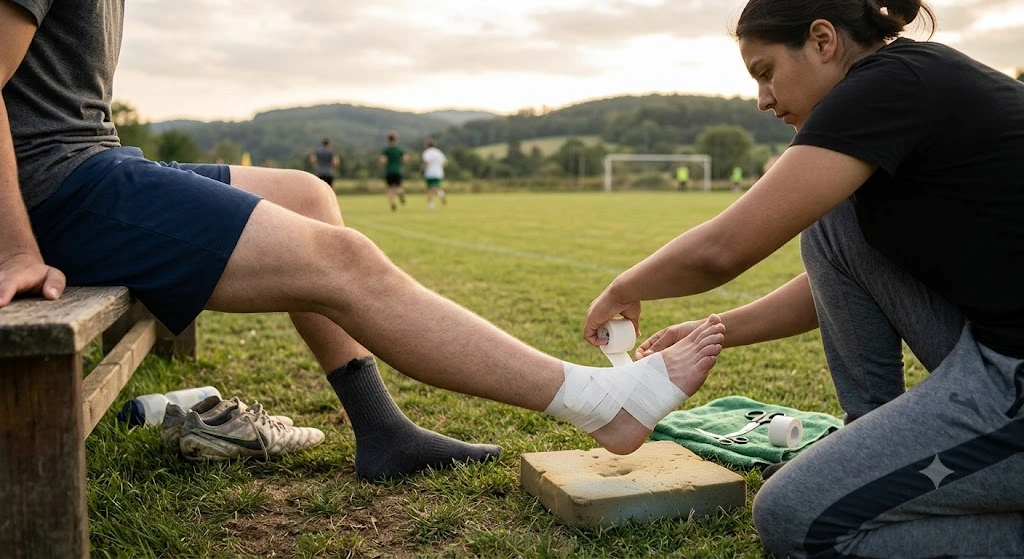
Image Source: Twitter
Sports Medicine Australia publishes a sports-trainer ankle-taping technique that uses anchors, stirrups, a figure of six and heel locks. The following is a simplified explanation of that published technique.
1. Prepare the ankle
Make sure the ankle and lower leg are clean and dry. If there is a wound, protect it before applying tape.
Position the foot at about 90 degrees. Sports Medicine Australia also recommends protective padding as part of its technique.
2. Apply the anchor strips
Place two strips around the lower part of the calf.
The second strip should overlap the first by approximately half the tape width. These strips provide the foundation for the rest of the tape application.
3. Add the stirrups
Sports Medicine Australia recommends two to three stirrups, depending on the size of the foot and ankle.
Start on the medial side of the ankle, cover approximately half of the ankle's bony prominence, pass the tape underneath the heel and finish at the lateral-side anchor.
Repeat the process, overlapping each stirrup by about half the tape width.
4. Add the figure of six
Begin from the medial-side anchor, take the tape underneath the heel and bring it back across the front of the ankle to the starting area.
This figure-of-six pattern adds another layer of support around the ankle.
5. Close down the stirrups
Starting above the ankle, apply separate strips down the leg.
Each strip should overlap the previous strip by about half its width until the stirrups are covered. Sports Medicine Australia's technique finishes this section around the malleoli, the bony areas on each side of the ankle.
6. Apply heel locks
The published technique uses two complete sets of heel locks.
The tape travels diagonally across the top of the foot, around the back and underneath the heel before returning across the front of the foot. The sequence is then repeated from the opposite side.
7. Finish and check the tape
A final piece of tape is placed gently around the midfoot to cover the edges of the heel locks.
This final check is especially important. Sports Medicine Australia advises checking distal capillary refill, movement, sensation and restriction after the tape has been applied.
If the foot becomes numb, unusually cold, discoloured or increasingly painful, the tape should not simply be left in place.
Should You Tape a Fresh Ankle Sprain?
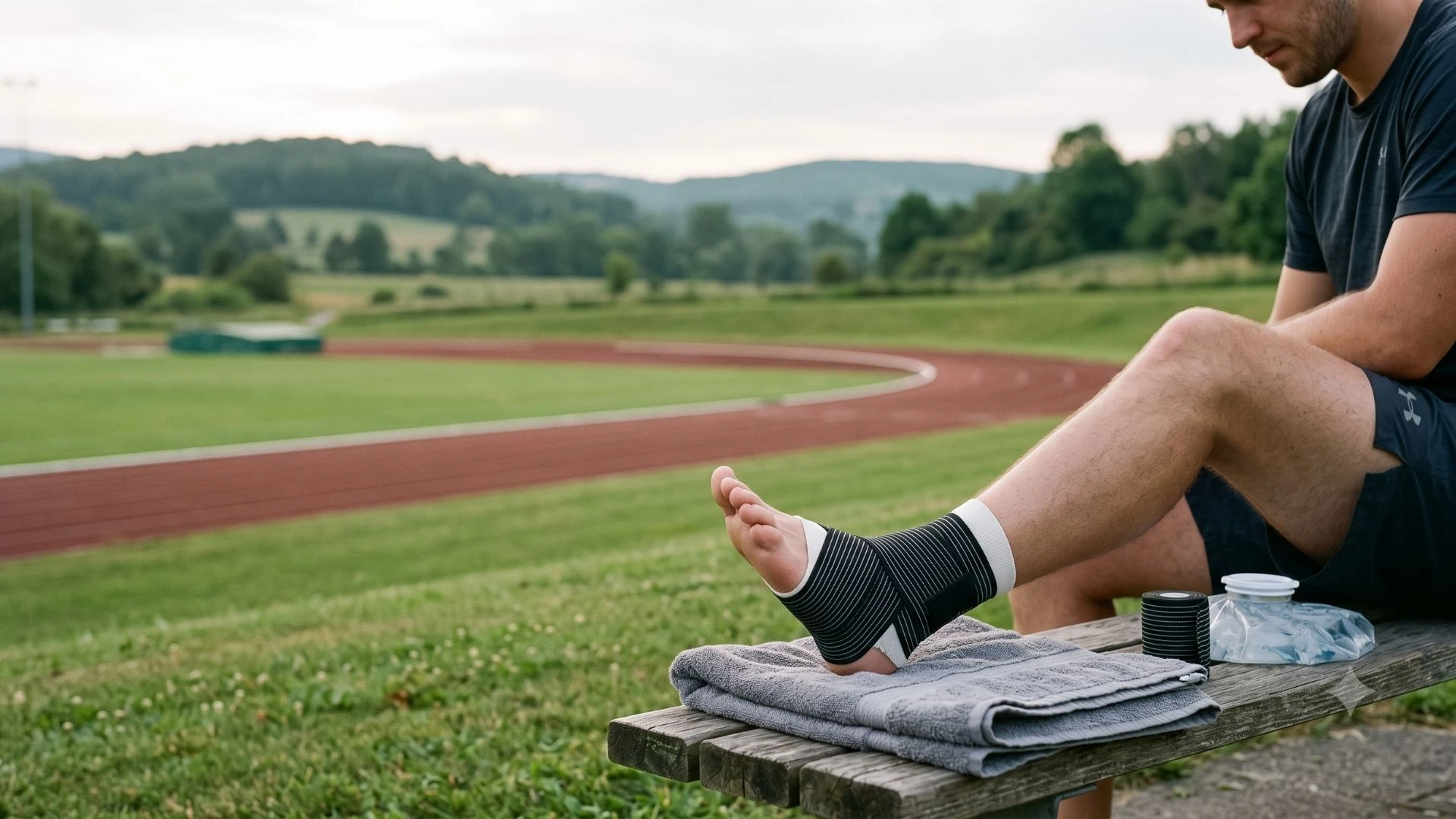
Image Source: Twitter
Not automatically.
A fresh ankle injury needs to be assessed based on its severity. The clinical practice guideline supports external supports such as taping or bracing for acute lateral ankle sprains, but the appropriate level of protection depends on the injury and the stage of recovery. More severe injuries may require greater protection or even temporary immobilisation.
Sports Medicine Australia advises getting a sports medicine professional to assess an ankle injury as soon as possible, particularly because diagnostic testing may sometimes be required.
A useful distinction is this: taping can support an injured ankle, but it does not establish whether the injury is a mild sprain, a more serious ligament injury or a fracture.
When Not to Tape and Play?
Do not use tape as a way to hide symptoms that need medical attention.
Seek urgent medical assessment if you have severe ankle pain, cannot walk, have significant swelling or bruising, notice that the ankle or foot looks deformed, or hear a snap, grinding or popping sound during the injury. These can indicate a more serious injury, including a fracture.
If the ankle remains painful or is not improving, professional assessment is also appropriate rather than repeatedly taping it and returning to sport.
Tape vs Ankle Brace
Both taping and bracing can provide external support.
The 2021 clinical practice guideline recommends prophylactic bracing for athletes at increased risk of a first lateral ankle sprain and recommends external support, including taping or bracing, during acute ankle-sprain management. It also recommends balance-focused rehabilitation for athletes recovering from an ankle sprain.
For athletes with previous ankle sprains, the guideline supports combining external support with proprioceptive and balance-focused exercises rather than treating tape or a brace as the entire rehabilitation program.
The American Academy of Paediatrics' HealthyChildren.org similarly notes that ankle braces or tape applied by a certified athletic trainer can provide additional support, particularly for athletes with previous ankle sprains, and cautions that improper use can affect mechanics and contribute to injury.
Can You Play Basketball or Volleyball With a Taped Ankle?

Image Source: Twitter
That depends on the injury and recovery stage.
Tape can provide external support, but it does not mean an athlete is automatically ready to return to competition. An international consensus on return-to-sport decisions after acute lateral ankle sprains recommends considering multiple factors rather than relying on one symptom or one test.
For a player returning after an ankle sprain, rehabilitation can include range-of-motion work, stretching, strengthening, balance training and sport-specific activities, depending on the injury. The clinical practice guideline recommends a structured therapeutic exercise component as part of rehabilitation.
The practical test is not simply whether the tape feels tight enough. The ankle needs to tolerate the movements required by the sport without significant pain or instability.
The Most Important Mistake to Avoid
Do not make the tape tighter just because the ankle feels unstable.
The goal is controlled support, not maximum compression. After taping, movement and sensation should remain normal, and circulation should be checked. Sports Medicine Australia's technique specifically includes checking capillary refill, movement and sensation.
For athletes who have never been taught sports taping, having an athletic trainer, physiotherapist or other qualified sports-health professional demonstrate the technique is safer than relying on a generic video or guessing where each strip should go.
What Helps Prevent Another Ankle Sprain?
Taping is only one part of the picture.
The 2021 clinical practice guideline recommends prophylactic bracing for people with risk factors for a first lateral ankle sprain and recommends bracing plus proprioceptive and balance-focused therapeutic exercise for people recovering from a first sprain.
Sports Medicine Australia also describes rehabilitation as including flexibility, balance, stretching, strengthening and sport-specific exercises, with taping or bracing potentially used while full function returns.
For basketball and volleyball players, that matters because the problem is not simply the moment the ankle rolls. Rebuilding strength, movement control and confidence can be an important part of getting back to repeated jumping, landing and changes of direction.
FAQ
Does taping an ankle help after a sprain?
Taping can provide external support after a lateral ankle sprain. Clinical practice guidelines recommend taping or bracing as external support during acute and postacute management, with the choice depending on injury severity and other factors.
Is taping good for basketball players?
Taping can provide ankle support for basketball players, particularly because basketball involves cutting, pivoting and jumping. Athletes with previous ankle sprains may have a higher risk of another sprain.
Is taping good for volleyball players?
Yes, ankle taping can provide external support for volleyball players. Volleyball is among the court sports associated with ankle-sprain risk because of jumping, landing and rapid movement.
Should I tape a swollen ankle?
Swelling after an ankle injury can occur with a sprain, but the severity matters. Significant swelling, severe pain, inability to walk or deformity should prompt medical assessment rather than simply applying tape and returning to sport.
Can I tape my ankle myself?
It is possible to learn the technique, but Sports Medicine Australia presents its detailed method as sports-trainer guidance. For an injured ankle, learning the technique from a qualified athletic trainer, physiotherapist or sports-medicine professional can help ensure the tape is applied appropriately.
Is an ankle brace better than tape?
There is no single choice that applies to every athlete. Clinical guidance considers factors including injury severity, healing stage, required protection, pain and personal preference when choosing between external supports such as taping and bracing.
Also Read: What Do Different Basketball Jersey Numbers Mean?