

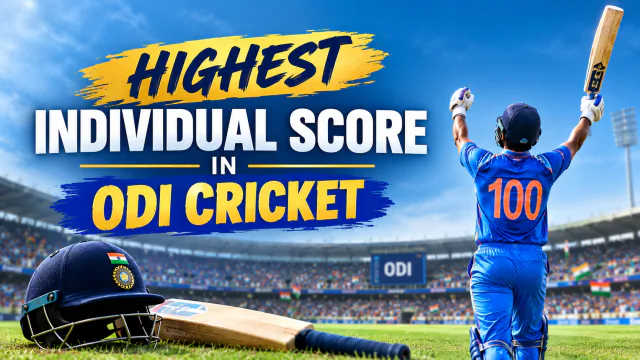
Rohit Sharma’s 264 against Sri Lanka at Eden Gardens in Kolkata remains the highest individual score recorded in an ODI innings in the available record lists. Made on 13 November 2014, the India opener faced 173 balls, struck 33 fours and nine sixes, and scored at a strike rate of 152.60. It was an innings that moved the limits of a 50-over individual score dramatically, surpassing the previous double-century landmarks in men’s cricket.
Why ODI batting records carry special weight
An ODI gives each side one innings, generally limited to 50 overs. That structure creates a distinct challenge for batters aiming for landmark scores. They must build an innings through the new-ball period, maintain control during the middle overs and accelerate without losing their wicket before the final phase. A double century therefore requires not only strokeplay, but time at the crease, fitness, partnerships and favourable match circumstances.
The highest individual score is also a record that spans men’s and women’s ODI cricket. That distinction matters when comparing lists. Rohit’s 264 was the leading score overall in the record summary published by Wikipedia, while Amelia Kerr’s unbeaten 232 for New Zealand is the highest score in women’s ODIs in the table dated 9 February 2024.
For readers following large scores across formats and international teams, TheCricScope can provide a useful wider context for cricket records and match performances. The key, however, is always to separate ODI records from domestic one-day cricket, T20 cricket and multi-day formats.
Rohit Sharma’s 264: the overall ODI benchmark
Rohit’s 264 against Sri Lanka was exceptional both for the final number and the distance he covered during the innings. His 33 fours accounted for 132 runs, while nine sixes added another 54. Those boundary runs alone totalled 186, leaving 78 runs scored through running and other non-boundary scoring.
The innings came after ODI cricket had already seen several major breakthroughs. Sachin Tendulkar became the first men’s player to score an ODI double century when he made an unbeaten 200 against South Africa in Gwalior on 24 February 2010. Virender Sehwag then made 219 against West Indies in Indore on 8 December 2011.
Rohit had also made 209 against Australia in Bengaluru in 2013 before his 264. He later scored an unbeaten 208 against Sri Lanka in Mohali in 2017. According to Wikipedia’s record summary, he is the only player to have recorded three ODI double centuries: 209, 264 and 208 not out.
The Indian double-century sequence
India’s history of major ODI scores includes several important milestones. Tendulkar’s 200 not out opened the door in men’s ODI cricket, while Sehwag raised the benchmark to 219 the following year. Rohit then took the record to 264, a figure that remains far beyond the other Indian double centuries listed in the available records.
Ishan Kishan made 210 against Bangladesh in Chattogram on 10 December 2022, facing 131 balls with 24 fours and 10 sixes. Shubman Gill followed with 208 against New Zealand in Hyderabad on 18 January 2023, making 19 fours and nine sixes from 149 balls. These innings show how rare the 200-run mark remains even in an era of high-scoring ODI cricket.
The leading women’s ODI scores
Women’s ODI cricket has its own remarkable history of record innings. Belinda Clark of Australia was the first player, male or female, to cross 200 in an ODI when she made an unbeaten 229 against Denmark in Mumbai on 16 December 1997. That score remained the overall ODI record until Rohit’s 264 in 2014.
Amelia Kerr set the women’s ODI record with an unbeaten 232 for New Zealand against Ireland in Dublin on 13 June 2018. The innings contained 31 fours and two sixes at a strike rate of 160.00. Wikipedia’s record summary also notes that Kerr was 17 when she reached her double century, making her the youngest player to do so.
| Rank | Player | Score | Team | Opponent | Venue | Date |
|---|---|---|---|---|---|---|
| 1 | Amelia Kerr | 232* | New Zealand | Ireland | Castle Avenue, Dublin | 13 June 2018 |
| 2 | Belinda Clark | 229* | Australia | Denmark | Middle Income Group Club Ground, Mumbai | 16 December 1997 |
| 3 | Chamari Athapaththu | 195* | Sri Lanka | South Africa | JB Marks Oval, Potchefstroom | 17 April 2024 |
| 4 | Deepti Sharma | 188 | India | Ireland | JB Marks Oval, Potchefstroom | 15 May 2017 |
| 5 | Laura Wolvaardt | 184* | South Africa | Sri Lanka | JB Marks Oval, Potchefstroom | 17 April 2024 |
| 6 | Chamari Athapaththu | 178* | Sri Lanka | Australia | Bristol County Ground, Bristol | 29 June 2017 |
| 7 | Sidra Ameen | 176* | Pakistan | Ireland | Gaddafi Stadium, Lahore | 4 November 2022 |
| 8 | Charlotte Edwards | 173* | England | Ireland | Nehru Stadium, Pune | 16 December 1997 |
| 9 | Harmanpreet Kaur | 171* | India | Australia | County Cricket Ground, Derby | 20 July 2017 |
| 10 | Stafanie Taylor | 171 | West Indies | Sri Lanka | Middle Income Group Club Ground, Mumbai | 3 February 2013 |
What the women’s top 10 reveals
The women’s top 10, as listed on 9 February 2024, contains two double centuries and a cluster of scores from 171 to 195. Five of those innings were unbeaten, highlighting how often a record score depends on a batter remaining at the crease through the full allocation of overs.
India has two entries in this women’s top 10. Deepti Sharma made 188 against Ireland at Potchefstroom in 2017, hitting 27 fours and two sixes. Harmanpreet Kaur’s unbeaten 171 against Australia at Derby in the 2017 Women’s World Cup included 20 fours and seven sixes. Both innings came in winning causes, according to the same table.
The table also underlines that a huge individual score does not always guarantee victory. Laura Wolvaardt’s unbeaten 184 for South Africa against Sri Lanka at Potchefstroom in April 2024 came in a losing effort. That result is a reminder that ODI batting records are individual achievements, while match outcomes remain shaped by both innings.
Earlier milestones on the road to 200
Before double centuries became part of ODI history, several innings pushed the benchmark forward. Glenn Turner made 171 for New Zealand against East Africa in Birmingham in June 1975, identified in the record summary as the first ODI score above 150. Kapil Dev’s unbeaten 175 for India against Zimbabwe in the 1983 World Cup was another major step.
Viv Richards then made an unbeaten 189 for West Indies against England at Old Trafford in 1984. Saeed Anwar reached 194 for Pakistan against India in Chennai in 1997, and Charles Coventry equalled that men’s ODI score with an unbeaten 194 for Zimbabwe against Bangladesh in Bulawayo in 2009.
These innings illustrate the changing scale of ODI batting. The record did not move in a straight line; it was shaped by improvements in fitness, boundary hitting, tactical aggression and the ability of openers to bat deep into an innings.
Records need the right context
A score should always be read alongside its format, opposition, venue, date and whether the batter was dismissed. An asterisk means the player remained not out. That can be particularly significant in ODI record lists, because an unbeaten batter may have had no further deliveries available or may have been denied a chance to add to the score after the innings ended.
Tournament context adds another layer. Martin Guptill’s unbeaten 237 against West Indies in Wellington during the 2015 Cricket World Cup was identified by Wikipedia as the highest individual score in any ICC tournament. It remains one of the clearest examples of a huge score produced on a global event stage.
Rohit Sharma’s 264 remains the defining ODI individual score in the available overall record summaries, while Amelia Kerr’s 232 not out stands at the top of the women’s ODI list dated February 2024. Together, those innings show the extraordinary endurance, timing and ambition required to turn a 50-over opportunity into cricket history.











Disclaimer
Possible11 is a sports news and analysis platform designed purely for entertainment and educational purposes. All match previews, player insights, and team analyses are based on publicly available information and expert opinions. We do not promote or support betting, gambling, or real-money gaming in any form. Users are encouraged to enjoy our content responsibly and use it for informational purposes only.








Give Your Feedback