

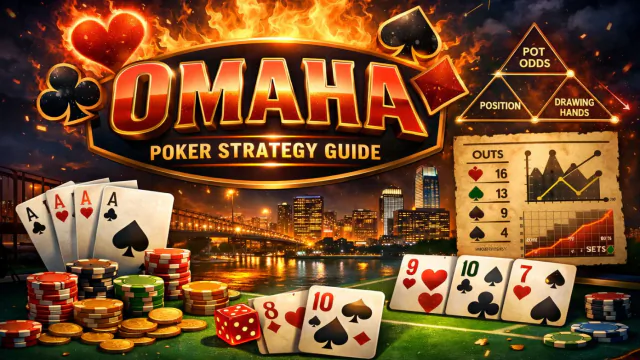
Omaha has become one of the most popular variants in modern poker, and it is easy to see why. The four-card format produces bigger hands, fatter pots, and far more action than the game most players learned first. Arrive expecting your Texas Hold'em instincts to carry you through, though, and the table punishes you fast. A sound Omaha poker strategy rests on different math, different hand values, and a sharper sense of risk.
The appeal is simple. More cards mean more ways to connect with the board, which keeps players involved and pots swelling. That same generosity is a trap, because everyone else also holds four cards. Learning poker Omaha the right way means accepting that strong-looking holdings are routine, and only the genuine nuts win money over time.
What Is Omaha Poker?
Omaha is a community-card game built in the same shape as Texas Hold'em: a flop, a turn, and a river, the same betting rounds, and the same poker hand rankings. The defining twist is the deal, as every player receives four hole cards instead of two.
The Omaha poker rules then add the constraint that trips up every newcomer: you must use exactly two of your four hole cards and exactly three community cards, no more and no fewer. Four hearts in hand plus one on the board is not a flush, because you can only ever use two of your own cards. Internalising this single rule is the foundation of every correct Omaha decision.
Omaha vs Texas Hold'em: Key Differences
The two games look like cousins, but the gaps run deep enough to demand a separate playbook. Knowing where Omaha and Texas Hold'em diverge is the fastest way to stop bleeding chips. The key contrasts:
- Hole cards: four in Omaha versus two in Hold'em, with the strict use of exactly two in your final hand.
- Hand strength: monsters arrive constantly, so two pair or a non-nut flush is often modest rather than a reason to commit your stack.
- Draw potential: four cards create huge combination draws that can outrun many made hands, reshaping pot odds on most streets.
- Variance: big hands collide more often, so swings are wider and disciplined bankroll habits matter far more than in Hold'em.
The lesson is recalibration. Holdings that win at showdown in Hold'em are frequently second best in Omaha, and equities between competing hands run much closer before the river.
Understanding Omaha Hand Selection
Because everyone is dealt four cards, raw high cards mean little. What matters is coordination: how well your four cards work together to make strong, nutted hands across many flops. The best Omaha starting hands share a few recognisable traits.
Connectedness is everything. Cards close in rank produce straights from several directions, while double-suited hands open two routes to the nut flush at once. A double-suited rundown is premium because it flops strong draws and made hands together. Players who practise on a reputable platform such as BCPoker casino soon learn to fold dangling cards, since a hand that is really only two useful cards plays like a weak Hold'em holding.
Position and discipline matter as much as card quality. Suited aces, big pairs with connectors, and tightly linked middle cards all gain value in late position. The math-first habits that sharpen players across other casino games, the kind championed by study resources like blackjackreview, apply here too: know your odds before the money goes in, and let weak, uncoordinated hands hit the muck without regret.
Playing Draws and Nut Hands Correctly
If Omaha has a single mantra, it is to chase the nuts and respect them. Drawing to anything less than the best possible hand is how stacks quietly disappear, because in a four-card game someone usually holds the top of the range.
Wrap draws, where connected cards give a dozen or more outs to a straight, are among the most powerful tools in the game and can be played aggressively when they target the nut end. Flush draws are valuable only when they are nut or near-nut; a middling flush draw is a classic trap. Above all, avoid second-best hands: the non-nut flush, the bottom end of a straight, and the underfull all look attractive and all lose stacks against a board hiding something stronger.
Pot-Limit Omaha (PLO) vs Limit Omaha
Omaha is dealt in two main betting formats, and the structure changes the correct approach. Pot Limit Omaha caps any bet at the current pot size, which still lets pots balloon street by street and rewards well-timed aggression on big draws. Limit Omaha fixes bet sizes, compressing variance into a more mechanical exercise of pot odds and value.
The adjustments follow from the math. PLO strategy leans on leverage, fold equity, and the threat of stacking opponents, so position and nut potential carry enormous weight. Limit Omaha rewards patience and precise calling. As for which format dominates, the answer is clear: Pot Limit Omaha is by far the more widely played version, running in nearly every cardroom and online lobby.
Common Omaha Poker Mistakes
Most losing Omaha players are not unlucky; they repeat the same handful of errors until variance does the rest. The recurring leaks:
- Overvaluing weak hands: treating two pair or a lone high pair as premium when four-card ranges crush them.
- Chasing non-nut draws: paying full price for low flushes and bottom straights that win only when already beaten.
- Ignoring board texture: missing paired boards, three-flushes, and connected runs that turn a strong hand into a costly bluff-catcher.
- Poor bankroll management: playing stakes too high for the swings, then going broke on a downswing proper sizing would absorb.
Fixing these is less about talent than honesty. Folding good-but-not-great hands, reading the board before the river, and respecting variance will do more for your results than any flashy bluff.
Bankroll Management for Omaha Players
Omaha's wide swings make bankroll management non-negotiable. Because equities run close and big hands clash often, even a strong player endures stretches a thin bankroll cannot survive. A larger cushion than you would keep for Hold'em is sensible, and many serious players hold fifty buy-ins or more for their regular stake.
Managing variance also means managing yourself. Move up only when your bankroll comfortably clears the next level, and step back down without ego when the numbers shrink. Treating each shot at higher stakes as a funded, calculated decision, rather than a reaction to a hot streak, keeps an edge alive long enough to pay off.
Practical Tips to Improve Your Win Rate
Once the fundamentals are in place, profit comes from small, repeatable habits. Table selection is the most underrated edge in poker: seek loose, passive games where opponents overplay weak hands, and leave tables where everyone is tight and competent. Position awareness compounds that edge, because acting last lets you control pot size and value-bet nutted hands with confidence.
Off the felt, the work continues. Reviewing big hands away from the heat of play exposes leaks you cannot feel in the moment, and continuous learning through books, training material, and honest discussion keeps your game ahead of the field. These Omaha poker tips cost nothing but discipline, and discipline is exactly what separates long-term winners from the crowd.
Omaha poker strategy
A winning Omaha poker strategy comes down to a few unshakeable principles: select coordinated starting hands, draw only to the nuts, read the board honestly, and protect your bankroll from the swings. None of it requires genius, but all of it requires discipline.
Omaha rewards the patient and punishes the reckless more harshly than almost any other variant. Think long term, fold the hands that flatter your ego, and let sound math rather than hope decide where your chips go. Play that way consistently, and the four-card game becomes one of the most profitable tables you will ever sit at.











Disclaimer
Possible11 is a sports news and analysis platform designed purely for entertainment and educational purposes. All match previews, player insights, and team analyses are based on publicly available information and expert opinions. We do not promote or support betting, gambling, or real-money gaming in any form. Users are encouraged to enjoy our content responsibly and use it for informational purposes only.












Give Your Feedback