

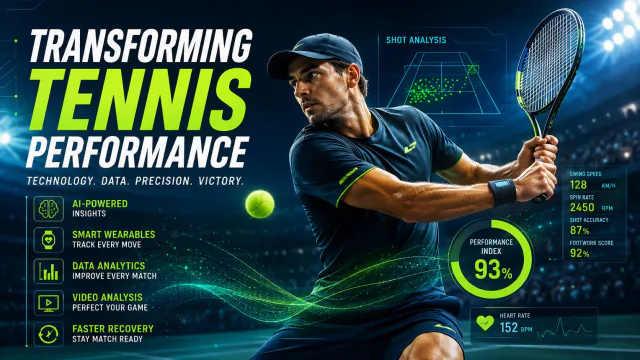
Tennis has always rewarded precision, but in 2026 that precision is being redefined by data and artificial intelligence. From AI-powered serve analysis to real-time biomechanical feedback, professional players and coaching teams now turn every shot into a measurable variable.
A Market Built on Data
The global AI in tennis market was valued at USD 0.72 billion in 2026 and is projected to reach USD 4.0 billion by 2033. The broader AI in sports market is forecast to grow from USD 13.10 billion in 2026 to USD 70.16 billion by 2035 at a CAGR of 21.6 percent.
Sports audiences who follow tennis through prediction platforms and digital communities, including users who access Lemon casino login features as part of a wider sports engagement routine, increasingly rely on the same data streams that professional coaching teams use.
Core Technologies in Professional Tennis
The following tools are now standard across ATP and WTA tour events and elite academies worldwide.
| Technology | Primary Function | Where It Is Used |
|---|---|---|
| Hawk-Eye Electronic Line Calling | Ball tracking accurate to within 2.6 mm | Three of four Grand Slams and major ATP and WTA events |
| AI Serve Analysis Apps | Biomechanical breakdown of serve mechanics in real time | Professional coaching clinics and elite academies |
| High-Speed Motion Tracking Cameras | Three-dimensional movement analysis across the full court | National training centres and Grand Slam venues |
| Wearable Biometric Sensors | Heart rate, fatigue index, and recovery monitoring | ATP and WTA tour training environments |
| Predictive Match Analytics Platforms | Head-to-head pattern and surface-specific performance modelling | Player coaching teams and sports data broadcasters |
What AI Is Doing Inside the Game
AI systems in tennis now analyse every shot a player hits across an entire season, identifying serve placement tendencies, return habits, and pressure-point patterns. Every serve analysis using modern tools captures hundreds of thousands of biomechanical data points per session.
Serve Analysis and Biomechanics
Serve performance sits at the centre of most AI coaching applications because it is the most statistically influential shot in the game.
- Ball toss consistency and peak height are tracked frame-by-frame, with AI flagging deviations of a few centimetres that human observation would miss during live play.
- Racket path angle and contact point position are mapped in three dimensions across hundreds of serves, identifying patterns most closely linked to double fault rates.
- Recovery time between first and second serve is monitored alongside physiological load data to detect fatigue-related technique breakdowns during long matches.
Tactical Preparation and Opponent Scouting
Before major tournaments, coaching teams use AI platforms to build detailed opponent profiles from historical match data, surface statistics, and pressure-point behaviour.
- Cross-court versus down-the-line return tendencies are mapped by surface type, allowing serving players to adjust placement strategy before the first point is played.
- Tiebreak and deciding-set performance data is weighted separately from overall statistics, giving a more accurate picture of how a player performs under maximum pressure.
- Historical patterns against left-handed opponents or players with unconventional serve motions are isolated and turned into targeted practice drills before the matchup occurs.
Electronic Line Calling and the Roland Garros Exception
As of 2026, Hawk-Eye electronic line calling is used at three of the four Grand Slams, with Roland Garros remaining the only major tournament to retain human line judges. The French Open's decision reflects ongoing debate about Hawk-Eye accuracy on clay, where the system's readings can conflict with visible ball marks left on the surface.
Impact Across the Tour
The shift to electronic calling has changed match dynamics and the officiating experience for players and fans alike.
| Area | Before Electronic Calling | After Electronic Calling |
|---|---|---|
| Line call accuracy | Subject to human error and viewing angle | Accuracy within 2.6 mm on every call |
| Match pace | Interrupted by player challenges and overrule reviews | Faster play with instant automated decisions |
| Player disputes | Frequent friction between players and line judges | Significantly reduced with objective data replacing opinion |
| Clay surface calls | Ball mark visible and used as final reference | Ongoing debate where Hawk-Eye and ball mark disagree |
The transformation in professional tennis reflects a broader pattern across sport in 2026, where AI and real-time data are raising the standard of both competition and analysis simultaneously. For fans, analysts, and fantasy sports users, tennis in 2026 is more transparent and data-rich than at any previous point in its history.
Frequently Asked Questions (FAQ)
What are smart tennis rackets?▼
How do wearable devices improve tennis performance?▼
Are technology-driven tennis tools only for professionals?▼












Disclaimer
Possible11 is a sports news and analysis platform designed purely for entertainment and educational purposes. All match previews, player insights, and team analyses are based on publicly available information and expert opinions. We do not promote or support betting, gambling, or real-money gaming in any form. Users are encouraged to enjoy our content responsibly and use it for informational purposes only.













Give Your Feedback