

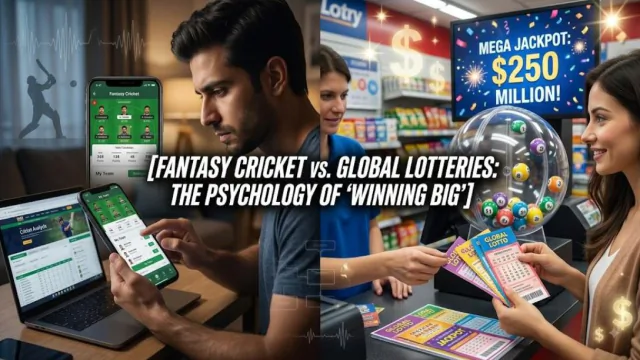
The Asymmetric Trap: Buying a Ticket Out of Reality
Human beings are tragically, predictably wired to chase asymmetric risk. You throw a handful of change at an infinitesimal mathematical probability and pray for a tectonic shift in your financial reality. Let's be real about what is actually happening within this ecosystem. The mechanisms we use to scratch this persistent itch essentially fall into two distinct operational buckets. Fantasy cricket demands relentless cognitive labor, statistical obsession, and a deep understanding of pitch degradation.
Global lotteries, conversely, require absolutely zero intellectual calorie expenditure. Both sit on opposite ends of the gaming spectrum; yet the underlying psychological engine driving a user to build an eleven-man IPL roster is identical to the one compelling someone to buy a Mega Millions quick-pick. The digital infrastructure of 2026 has completely obliterated the historical barriers separating these two worlds. You no longer have to walk to a bodega or wait for the Sunday paper to find out if your life just changed.
The Balance Sheet Reality Check: Skill is a Taxable Myth
Legal scholars absolutely love to debate the exact demarcation line between skill and chance. The "Dominant Factor Test" usually serves as the golden rule in courtrooms, separating strategic investors from reckless gamblers. MIT researchers even proved years ago that daily fantasy sports inherently reward skill, showing that outcomes drift far away from simple coin flips. Platforms like Dream11 aggressively flaunt this empirical data to prove their 300 million users are savvy sports managers.
But let's be explicitly clear-that academic distinction vaporizes the second the tax authorities come knocking. Regulatory bodies have entirely stopped caring about a player's strategic win-rate. Take the Indian taxation paradigm shift of 2026 as the ultimate, brutal proof of this reality. The Supreme Court of India absolutely nuked the economic moat around fantasy sports by upholding a 28% Goods and Services Tax on the full face value of player deposits. The court essentially declared that staking money on any uncertain outcome is just betting, pure and simple. The regulatory landscape worsened with the Promotion and Regulation of Online Gaming Act of 2025, which practically banned expectation-based deposit games outright. This $30 billion retrospective tax bomb proved one definitive thing. When you put capital on the line for an unpredictable event, governments view your deep dive into cricket analytics exactly the same as a randomized plastic ball dropping from a machine.
Hijacking the Brain's Reward Ledger
Behavioral economists rely heavily on Prospect Theory to explain why we willingly torch our cash on negative expected value propositions. We systematically overweight tiny probabilities because our brains literally cannot process the sheer scale of a one-in-300-million denominator. A subjective, emotionally charged psychological weight completely replaces objective mathematics. You aren't actually buying a ticket. You are purchasing the temporary, high-octane optimism that exists between the transaction and the final draw.
Look closer at the neurobiology, and the picture becomes even more predatory. Midbrain dopamine neurons do not fire just because you won a few dollars. They fire precisely because you anticipated a reward that was highly uncertain-a phenomenon known as the Reward Prediction Error. If an outcome is guaranteed, your prefrontal cortex gets bored instantly. It is the agonizing suspense-the final ball of a high-stakes T20 match or the slow reveal of a scratch-off card-that triggers a massive, highly addictive neurochemical surge. Emerging genetic research even suggests that variations in specific dopamine receptor genes, like DRD2, create a hardwired biological predisposition for this exact compulsion in a significant chunk of the population.
Weaponizing the Near Miss
Platform operators understand this biological circuitry vastly better than most clinical therapists. They weaponize the "Near Miss" effect with terrifying, algorithmic efficiency. Your fantasy captain falls a single run short of a massive century bonus. You match five out of six jackpot numbers on a multi-state draw. Objectively, your wallet is lighter and you lost the game. Neurologically, your ventral striatum processes that near miss as a massive win, flooding your nervous system with dopamine and convincing your ego that success is absolutely imminent.
These developers also love to deploy Losses Disguised as Wins (LDWs) to bleed you dry slowly. You wager ten dollars on a micro-bet, win back three, and the mobile app immediately throws a digital parade of flashing lights and celebratory audio. Your actual bankroll is hemorrhaging cash, but your brain genuinely thinks you are a champion. This sensory feedback intentionally bypasses your cognitive brake pedal, accelerating continuous, rapid-fire play until the deposit balance hits zero.
Ego Management and the Illusion of Control
Hand someone a totally chaotic system. Let them pick a few irrelevant buttons to push. Within seconds, that person genuinely believes they control the destiny of the game. You see this everywhere with jackpot chasers, who refuse to let a computer generate their numbers. A machine pick holds the exact same mathematical weight, yet people cling to their grandkids' birthdays or scribble diagonal lines across the slip like it actually matters.
Look at the psychological frameworks here, specifically what academics call Self-Determination Theory. We all have a primal itch for three things: feeling capable, making our own choices, and connecting with a tribe. Building an IPL roster feeds that deep-seated need for competence on an industrial scale. This gamification transforms passive couch consumption into an intellectual battlefield, validating a user's sporting identity among their peers. Lotteries lean heavily into the relatedness aspect. Digital syndicates and office pools allow coworkers to share the financial risk and chase the collective dopaminergic rush as a tribal unit.
Frankly, fantasy sports players suffer from a much more dangerous strain of this cognitive bias. They consistently mistake information for insulation against risk. An exhaustive analysis of player matchups creates a potent psychological narrative of absolute control. The actual outcome of the match, however, is still dictated by chaotic variables nobody can model. A sudden hamstring tear or a dropped catch routinely ruins a perfectly optimized, data-driven lineup. A victory convinces the player of their innate genius. Defeats are quickly, reflexively blamed on terrible officiating or pure bad luck. This self-serving attribution bias powerfully protects the ego, allowing users to frame their recreational gambling as a highly sophisticated investment strategy.
The Frictionless Conveyor Belt of Asymmetric Capital
The boundaries separating the spreadsheet-wielding sports nerd from the casual lottery dreamer evaporated completely by the mid-2020s. These activities used to occupy entirely different demographic spaces, separated by friction and physical distance. That isolation is permanently gone. Both ecosystems now coexist seamlessly on a single pane of glass in your pocket. You used to have to trudge down to a fluorescent-lit corner store just to buy a ticket. The modern consumer skips that depressing physical step entirely. Millions now play the lottery online using heavily vetted courier apps, which legally secure the paper receipt in a vault while wiring the digital winnings straight to your phone.
That monstrous $750 million DraftKings acquisition of Jackpocket perfectly maps out the future of this space. The corporate strategy is brilliant, seamless, and utterly ruthless. The catch? The lottery courier app functions as a remarkably cheap, high-volume customer acquisition engine. Once a casual player downloads the software to chase a billion-dollar Powerball rollover, the operator immediately cross-sells them into the higher-margin, high-frequency bloodbath of daily fantasy and in-game micro-betting.
The House of Consolidated Hope
DraftKings and their peers no longer care if you consider yourself a statistical mastermind or just a lucky guesser. They own the entire spectrum of human hope-from the calculated to the absurd. Institutional risk management is now just a seamless digital conveyor belt. It moves consumer capital effortlessly from the illusion of skill directly into the cold mathematics of chance, all while your smartphone aggressively buzzes with the promise of the next big hit.











Disclaimer
Possible11 is a sports news and analysis platform designed purely for entertainment and educational purposes. All match previews, player insights, and team analyses are based on publicly available information and expert opinions. We do not promote or support betting, gambling, or real-money gaming in any form. Users are encouraged to enjoy our content responsibly and use it for informational purposes only.











Give Your Feedback