
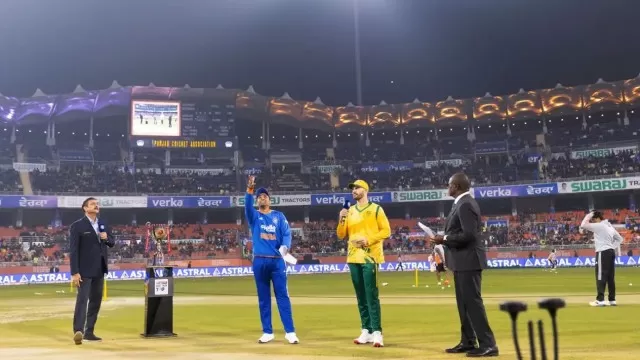
New Chandigarh welcomed fans with an electric atmosphere as the city hosted its first-ever men’s international cricket match. Excitement rippled through the stadium long before the toss, with spectators eager to witness a historic clash between India and South Africa. The surface had already gathered a faint layer of dew during warm-up, and players were seen assessing the conditions closely to prepare for the game’s unfolding challenges.
The evening carried a festive charm, as the crowd buzzed with anticipation of how the pitch—known for its pace-friendly nature—would behave under lights. For India, this fixture carried immense significance, not only as a chance to level tactical strategies but also as an opportunity to test consistency in challenging conditions. Dewy conditions played a crucial role in shaping the match narrative before the first ball was even bowled.
South Africa entered the ground with a defined rotation strategy, looking to fine-tune combinations ahead of future assignments. Their camp remained positive despite making notable alterations to the previous lineup. India, however, backed a stable team composition, arriving with confidence after evaluating conditions that promised to influence every phase of play.
Dew Conditions Shape India's Decision to Bowl First
India’s captain, Suryakumar Yadav, chose to field first after confirming that dew had already settled across the outfield. During the warm-ups, the surface appeared slick, instantly signalling trouble for bowlers defending a total later in the match. As the evening progressed, conditions were projected to get even wetter, prompting a decision that aligned tightly with the team's understanding of the venue.
The pitch in New Chandigarh has gained recognition during domestic and IPL fixtures for favouring fast bowlers, often rewarding seam and bounce. With the ground hosting its first men’s international game, India’s management anticipated similar behaviour under lights, which further reinforced their decision. Fielding first gave the bowlers the early advantage of a dry ball and fuller grip, essential for executing plans with precision.
The unchanged Indian lineup showcased faith in the existing combination. India resisted the temptation to include a second wrist-spinner, as the pitch’s characteristics leaned more toward pace. Instead, they prepared to unleash an attack built around variations from pacers and controlled spells from all-rounders who adapt well to evolving conditions.
South Africa’s Strategic Adjustments for Balance
South Africa made bold and calculated decisions by bringing in Reeza Hendricks, Ottneil Baartman, and George Linde. Captain Aiden Markram reiterated that these were rotation-based selections aimed at keeping key players fresh and testing the squad’s depth. Their strategy also accounted for the pace-friendly pitch, prompting them to utilize fresh resources capable of adapting quickly.
Reeza Hendricks’ inclusion fortified the top order with stability and experience, while Baartman’s entry added pace potency to their attack. George Linde offered versatile spin-bowling coupled with batting depth, giving South Africa improved roster balance. The dropped players—Tristan Stubbs, Anrich Nortje, and Keshav Maharaj—were part of a planned rotational approach rather than form-driven omissions.
By reshuffling their lineup, South Africa aimed to match India’s strategic clarity and exploit conditions with energy and innovation. Their new combination brought additional fielding agility and offered the potential to disrupt India’s plans with unfamiliar match-ups.
Full Playing XIs Announced Before the Clash
Both teams announced their playing elevens with a mix of confidence and clarity. India fielded the following XI:
- Abhishek Sharma
- Shubman Gill
- Suryakumar Yadav (captain)
- Tilak Varma
- Jitesh Sharma (wicketkeeper)
- Hardik Pandya
- Shivam Dube
- Axar Patel
- Arshdeep Singh
- Varun Chakravarthy
- Jasprit Bumrah
The Indian XI reflected a harmonious blend of power hitters, versatile all-rounders, and match-winning bowlers. Suryakumar’s leadership combined strategic sharpness with an aggressive mindset, crucial for navigating dew-laden conditions. The pace attack featuring Bumrah and Arshdeep looked primed for early breakthroughs, while the middle overs were entrusted to Axar Patel and Varun Chakravarthy for variation and control.
South Africa responded with the following lineup:
- Quinton de Kock (wicketkeeper)
- Reeza Hendricks
- Aiden Markram (captain)
- Dewald Brevis
- David Miller
- Donovan Ferreira
- George Linde
- Marco Jansen
- Lutho Sipamla
- Lungi Ngidi
- Ottneil Baartman
The Proteas assembled a team rich with hitters and capable all-rounders, with a pace attack structured to leverage bounce and seam movement. Their XI displayed intent and confidence, positioning themselves as strong challengers in a venue new to international cricket but familiar in characteristics to the IPL circuit.
Historic First Men’s International Match at New Chandigarh
New Chandigarh’s debut in men’s international cricket added special significance to the contest. The stadium, long admired for its IPL fixtures, finally embraced the global spotlight with fans filling the stands in vibrant colours. This milestone brought immense pride to local supporters who had eagerly awaited the moment to host a world-class cricketing spectacle.
The infrastructure, atmosphere, and energy blended to create a memorable opening chapter for the venue. The contest between India and South Africa offered a fitting inauguration—two elite cricketing nations competing under the unique challenges of dew and pace-friendly dynamics. The stage was set for a riveting clash that would be remembered as the night New Chandigarh officially entered the world cricket map.
As the players took their positions and the lights intensified, anticipation rose for a match shaped by strategy, conditions, and psychological edge. The combination of history, tactical adjustments, and evolving conditions promised a gripping showdown under the dewy skies of New Chandigarh.
Also Read: IPS officer reveals shocking story of slapping Sanjay Dutt










Disclaimer
Possible11 is a sports news and analysis platform designed purely for entertainment and educational purposes. All match previews, player insights, and team analyses are based on publicly available information and expert opinions. We do not promote or support betting, gambling, or real-money gaming in any form. Users are encouraged to enjoy our content responsibly and use it for informational purposes only.




Give Your Feedback