
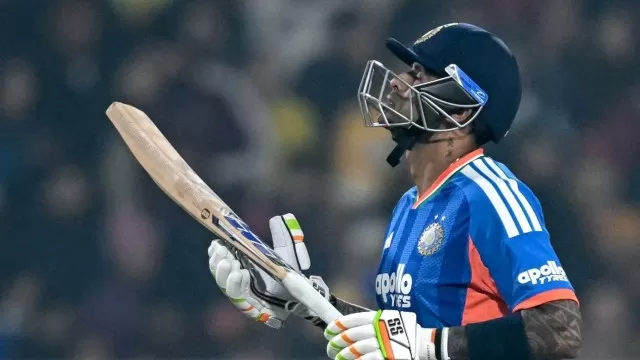
Suryakumar Yadav’s slump in form has come under intense scrutiny once again after a disappointing outing in the second T20I against South Africa. In a match where India desperately needed stability, the star batter’s early dismissal exposed deeper concerns about his recent performances and tactical decisions. Over the past year, Suryakumar’s numbers have dipped sharply, raising questions about his readiness for the upcoming T20 World Cup.
The situation intensified when India suffered a heavy defeat, their second-largest loss by runs in T20Is. As other batters also faltered, Suryakumar’s continued low returns highlighted the pressure he faces both as a key batter and as captain. His shift to No. 4, despite early wickets falling, left many puzzled and contributed to India’s inability to build momentum during the chase.
While India’s overall depth has allowed them to win games despite his decline, this latest setback has forced fans and analysts to look closely at the pattern of dismissals and tactical missteps. As the cricketing world debates India’s roadmap for the World Cup, all eyes are on Suryakumar—once the most explosive T20 batter in the world—now fighting to rediscover his spark.
Suryakumar Yadav’s Decline in Numbers and Its Growing Impact
Suryakumar’s prolonged poor form has started to influence India’s batting strategies. Since November 2024, he has scored only a modest number of runs despite playing 20 innings, and his average and strike rate have both dipped well below his elite standards. His once-feared 360-degree stroke play has not translated into impactful innings lately, with most of his stays at the crease ending within a few deliveries.
Against South Africa, his latest failure came when he edged a delivery behind the stumps after facing only a handful of balls. The early movement on offer created trouble for India’s top order, and Suryakumar’s inability to weather that phase contributed to India’s collapse. This lean spell has featured a wide variety of dismissals—caught behind, caught in the deep, played-on—suggesting a broader issue with rhythm and timing rather than a specific technical flaw.
Aakash Chopra and several other analysts have pointed out that his place in the XI could come under scrutiny if the trend continues. With the World Cup approaching, India cannot afford instability in crucial positions, especially in the top four where matches are often won or lost.
Tactical Decisions Under the Scanner: The No 3 Debate
One of the most debated moments of the match came when Suryakumar chose to drop himself to No 4 instead of taking the No 3 spot after an early wicket. This move resulted in Axar Patel being promoted to No 3 for the first time in his international T20 career. The decision backfired almost immediately, as Axar struggled to find fluency amid swinging conditions that demanded skill and experience in playing pace bowling.
Normally used as a middle-order disruptor against spin, Axar was exposed too early, while Tilak Varma, another dependable option for the No 3 position, was held back. As a result, India lost momentum and failed to counter South Africa’s seam attack effectively. Adding to the tactical misstep was the fact that neither Axar nor Dube faced the left-arm spinner, who bowled economically without facing a real test.
Suryakumar acknowledged after the match that the batting order experiment did not unfold as expected. He admitted that he and Shubman Gill needed to take more responsibility instead of leaving the burden on others. Despite his acceptance of the error, critics argue that Team India’s strategies in crunch moments require sharper judgment moving forward.
India’s Rare Collective Failure Highlights Dependency on Key Players
India entered the second T20I with an impressive run of success over the past twelve months, having lost only a handful of matches. Much of that dominance stemmed from the team’s deep bench strength, which allowed them to overcome individual failures. However, the match against South Africa exposed how quickly the balance can shift when multiple batters underperform simultaneously.
With early wickets falling, the middle order was forced into damage control rather than acceleration. Suryakumar’s early dismissal, followed by Axar’s slow innings, left India chasing the game from the start. Despite the presence of dew, which should have helped India’s chase, South Africa dominated with disciplined bowling and fielding, maintaining control throughout the innings.
This defeat serves as a reminder that even a strong team cannot compensate indefinitely for prolonged slumps in key positions. As one of India’s most explosive T20 batters, Suryakumar’s return to form is crucial for stability and success in upcoming high-stakes matches.
Patterns of Dismissal and the Mental Battle Ahead
Looking at Suryakumar’s dismissals over the last year, no single weakness stands out. Pace bowlers have gotten him out in various ways, suggesting not a technical fault but a psychological or rhythm-related issue. With modern bowlers studying footage meticulously, even the smallest dip in a batter’s confidence or timing becomes magnified.
While his failures have been frequent, they do not necessarily define his future. T20 cricket—by nature—encourages high-risk, high-reward gameplay. Players who succeed in this format often go through extreme highs and lows. Suryakumar has previously shown the ability to bounce back strongly after lean patches, proving that loss of form does not equate to loss of ability.
Nonetheless, with big tournaments ahead and captaincy responsibilities weighing on his shoulders, the mental aspect of his game will be critical. Whether he can regain the clarity, freedom, and aggression that once made him a global superstar remains a question that only time will answer.
IPL Turnaround Gives Hope for a Comeback
Fans and analysts often refer to Suryakumar’s stunning turnaround during the IPL 2025 season as proof of his resilience. After an average run against England just before the tournament, he transformed himself dramatically, finishing as one of the top scorers with an outstanding average and blistering strike rate. His ability to dismantle bowling attacks and find innovative scoring areas returned in full force, silencing critics.
That resurgence played a major role in propelling Mumbai Indians deep into the competition. It also showcased his capacity to adapt, correct flaws, and peak at the right time. Indian team management will be hoping for a similar revival as the T20 World Cup approaches, particularly with India hosting the mega event.
While recent performances have raised concerns, the memory of his IPL heroics continues to provide optimism. Many believe that one good innings could trigger a shift in momentum, restoring his confidence and making him the match-winner he has always been.
Looking Ahead: Can Suryakumar Reignite His Spark Before the World Cup
With upcoming fixtures offering opportunities for experimentation and recalibration, Suryakumar has a window to rebuild his form. India’s management faces crucial decisions concerning his batting position, workload, and role in shaping the batting order. Whether he sticks to No 3, continues at No 4, or experiments further will be closely watched.
The team will also look to refine its tactical approach, avoiding unnecessary risks such as promoting players out of their natural roles during high-pressure situations. As the tournament nears, India cannot rely solely on depth; they require their star performers to lead from the front.
Ultimately, Suryakumar’s journey back to his best will depend on clarity of mind, trust in his instincts, and the ability to block out outside noise. The World Cup stage has often produced heroes out of slumps, and fans hope SKY will script a similar comeback story.
- India will reassess batting order strategy for upcoming matches.
- Suryakumar aims to regain confidence through consistent match time.
- Team management focuses on stability ahead of major tournaments.
- Past turnarounds fuel hope for another strong comeback.
Also Read: New Zealand Overtake Pakistan and India in WTC27 Race










Disclaimer
Possible11 is a sports news and analysis platform designed purely for entertainment and educational purposes. All match previews, player insights, and team analyses are based on publicly available information and expert opinions. We do not promote or support betting, gambling, or real-money gaming in any form. Users are encouraged to enjoy our content responsibly and use it for informational purposes only.










Give Your Feedback