
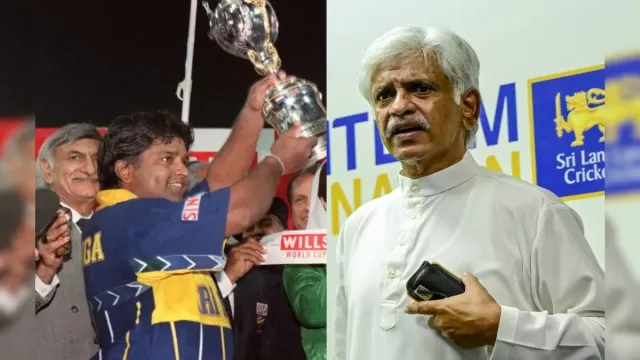
Shockwaves have rippled across Sri Lanka’s political and sporting landscape after authorities informed a court of plans to arrest legendary cricketer and former minister Arjuna Ranatunga over alleged corruption linked to an oil procurement case. The development has stunned fans who remember Ranatunga as the fearless leader who guided Sri Lanka to its historic 1996 World Cup triumph.
The allegations relate to decisions taken during Ranatunga’s tenure as petroleum minister, when procurement procedures were allegedly altered, resulting in substantial financial losses to the state. As legal proceedings gather momentum, the case has reignited debate around accountability, governance, and the fine line between sporting heroism and public responsibility.
With multiple members of the Ranatunga family already facing scrutiny, the unfolding saga has become emblematic of Sri Lanka’s broader anti-corruption drive, raising critical questions about transparency and reform at the highest levels of power.
Arjuna Ranatunga and the Alleged Oil Procurement Irregularities
According to submissions made before a Colombo magistrate, Arjuna Ranatunga and his brother are accused of modifying established procedures for awarding long-term oil procurement contracts. Instead of adhering to structured tender mechanisms, authorities allege that spot purchases were made at significantly higher prices, placing an undue financial burden on the state.
The Commission to Investigate Allegations of Bribery or Corruption has estimated that 27 such transactions resulted in losses amounting to nearly 800 million Sri Lankan rupees, roughly equivalent to Rs 23.5 crore. These decisions, allegedly taken in 2017, form the crux of the case now before the courts.
Investigators maintain that the changes were neither incidental nor administrative oversights, but deliberate deviations that benefitted certain suppliers at the expense of public funds, a charge that has placed Ranatunga under intense legal and public scrutiny.
Legal Proceedings and Court Developments
The Colombo Magistrate was informed that Arjuna Ranatunga is currently overseas and will be taken into custody upon his return to Sri Lanka. The court has been closely monitoring developments, with authorities assuring that due legal process will be followed once he re-enters the country.
In a related move, Ranatunga’s elder brother Dhammika Ranatunga, who served as chairman of the state-owned Ceylon Petroleum Corporation at the time, was arrested earlier and subsequently released on bail. The court imposed a travel ban on him, citing the seriousness of the allegations and the need to ensure cooperation with investigators.
The next hearing in the case has been scheduled for March 13, a date that is expected to bring further clarity on the direction of the prosecution and the potential charges that may be formally framed.
The Wider Anti-Corruption Crackdown in Sri Lanka
The case against the Ranatunga brothers is part of a broader campaign launched by the government of President Anura Kumara Dissanayake, who assumed office on a strong mandate to combat entrenched corruption. The administration has signaled that no individual, regardless of stature or past achievements, will be exempt from investigation.
Several high-profile cases have emerged under this renewed focus, underscoring a shift in political will toward greater accountability. Analysts view the action against a national sporting icon as a defining moment that could either strengthen public faith in institutions or intensify political polarization.
The government’s approach has drawn both praise and criticism, with supporters hailing it as overdue reform and detractors questioning timing and intent. Nevertheless, the Ranatunga case has become a central symbol of this evolving narrative.
Arjuna Ranatunga: From Cricketing Legend to Political Figure
Arjuna Ranatunga, now 62, occupies a unique place in Sri Lanka’s collective memory. As captain of the national cricket team, he led the island nation to its first and only Cricket World Cup victory in 1996, defeating Australia in a final that transformed Sri Lankan cricket forever.
Known for his bold leadership and tactical acumen, Ranatunga later transitioned into politics, holding ministerial portfolios including petroleum. His move from the cricket field to public office was widely seen as a natural progression for a figure of his influence.
However, the current allegations threaten to overshadow his sporting legacy, forcing the public to reconcile his past achievements with the serious questions now being raised about his conduct in public life.
Family Under Scrutiny: Multiple Cases Against the Ranatungas
The controversy does not stop with Arjuna Ranatunga alone. His younger brother Prasanna Ranatunga, a former tourism minister, was arrested recently in connection with an alleged insurance fraud case. That matter remains pending before the courts.
Prasanna had earlier been convicted in June 2022 on charges of extortion involving a businessman and is currently serving a two-year suspended prison sentence. These developments have collectively placed the Ranatunga family at the center of an unprecedented legal spotlight.
Observers note that the clustering of cases has intensified public interest and debate, with many questioning whether systemic issues within political families are finally being addressed.
Public Reaction and Political Implications
The news of a potential arrest has sparked intense discussion across Sri Lanka, particularly among cricket fans who grew up idolizing Ranatunga. For many, the allegations represent a painful reckoning between nostalgia and the realities of governance.
Politically, the case is expected to reverberate through Parliament and beyond, as opposition figures and ruling party members alike weigh in on its implications. Some see it as a warning to current office-holders, while others fear it could deepen cynicism toward political leadership.
As the investigation proceeds, public sentiment is likely to evolve, shaped by courtroom revelations and the credibility of evidence presented.
What Lies Ahead for the Case
With Arjuna Ranatunga’s return to Sri Lanka anticipated, authorities are preparing for the next phase of legal action. His arrest, if carried out, would mark one of the most high-profile detentions of a former sports icon turned politician in the country’s history.
The forthcoming hearings will be critical in determining whether the prosecution can substantiate claims of procedural manipulation and financial loss. Legal experts suggest the outcome could set an important precedent for future corruption cases.
Until then, the nation watches closely as a chapter unfolds that intertwines sport, politics, law, and the ongoing quest for accountability in Sri Lanka.
Also Read: Firouzja Shocks Caruana as Global Chess League Opens



Disclaimer
Possible11 is a sports news and analysis platform designed purely for entertainment and educational purposes. All match previews, player insights, and team analyses are based on publicly available information and expert opinions. We do not promote or support betting, gambling, or real-money gaming in any form. Users are encouraged to enjoy our content responsibly and use it for informational purposes only.




Give Your Feedback