

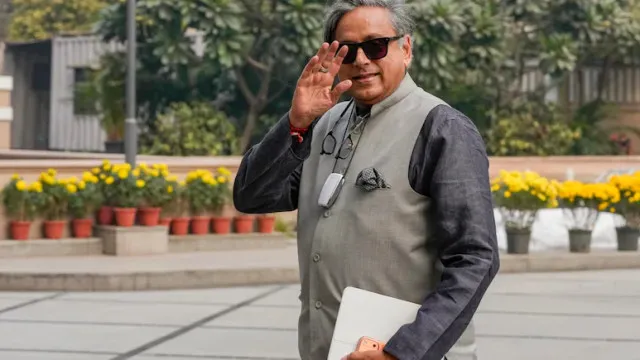
Indian politics once again found itself at the centre of public debate after a seemingly casual social media post triggered a sharp political exchange. What began as a selfie shared online soon evolved into a larger discussion about loyalty, perception, and the fragile equations within political parties.
The controversy gained momentum when reactions poured in from rival leaders, transforming a moment of praise into a political flashpoint. As narratives formed across social media and news platforms, the episode highlighted how even informal gestures can carry deep political meaning.
At the heart of the discussion stood Congress MP Shashi Tharoor, whose words and actions have increasingly drawn attention from both supporters and critics amid shifting political dynamics.
Selfie That Sparked a Political Storm
The episode began with Shashi Tharoor posting a selfie with former BJP MP and current India men’s cricket team coach Gautam Gambhir. The post was shared shortly before an international cricket match, adding to its visibility.
In the caption, Tharoor praised Gambhir for handling what he described as the second-hardest job in the country, placing only the Prime Minister above it in difficulty. The remark, though light in tone, quickly drew political interpretations.
Once the image went viral, political reactions followed swiftly, turning a casual post into headline news.
BJP Leader Leads the Counterattack
BJP spokesperson Shehzad Poonawalla emerged as the most vocal critic following the post. He seized upon Tharoor’s comparison and used it to launch a broader attack on the opposition.
Poonawalla drew parallels between cricket fans questioning team strategy and opposition parties questioning government decisions. According to him, constant criticism weakens national interest.
The response reframed Tharoor’s praise as indirect validation of the Prime Minister’s leadership, intensifying political sparring.
One More Fatwa Remark Draws Attention
The phrase that dominated headlines was Poonawalla’s taunt predicting one more Congress fatwa against Tharoor. The remark referenced ongoing tensions between the MP and his party’s central leadership.
The comment suggested that Tharoor’s independent views often place him at odds with the Congress establishment.
Such wording immediately caught public attention, reigniting debates about dissent and discipline within political parties.
Kerala Election Context Adds Fuel
The timing of the controversy is particularly significant with assembly elections approaching in Kerala. Political narratives during election seasons often gain heightened sensitivity.
The BJP has been actively seeking opportunities to challenge the Congress narrative in the state.
Tharoor’s national stature and popularity in Kerala make any controversy surrounding him politically consequential.
Tharoor Reputation as a Diplomat and Intellectual
A diplomat by training, Shashi Tharoor has long been known for his articulate views and independent thinking.
His background in international affairs often shapes his commentary on national and global issues.
This intellectual independence has earned admiration but also friction within party structures.
Thin Ice With Congress Leadership
Tharoor is widely seen as being on thin ice with the Congress’ central leadership after comments that appear to praise the Prime Minister and the ruling BJP.
While his supporters view these remarks as objective assessments, critics within the party see them as deviation from collective messaging.
This tension has resurfaced repeatedly over the past year.
Past Comments That Triggered Unease
Several of Tharoor’s earlier remarks have stirred internal discomfort within the Congress.
His observations on national security decisions and crisis management were interpreted by some as too generous toward the government.
These statements became reference points whenever questions of party loyalty emerged.
Article on Family Politics Deepened Rift
Don’t know what will trigger Congress more
— Shehzad Jai Hind (Modi Ka Parivar) (@Shehzad_Ind) January 22, 2026
Tharoor in Nagpur
Tharoor meeting & praising Gautam Gambhir
Or
Tharoor’s acknowledgement that PM Modi has the hardest job in India given how he is second guessed by an opposition that puts Parivarik interests above Bharat’s… pic.twitter.com/LmkfEgE1RC
In November last year, Tharoor authored an article critiquing family-led political systems.
The piece was widely read as a commentary on dynastic politics, a sensitive subject within the Congress.
The reaction from party insiders was reportedly far from positive.
BJP Capitalises on Internal Congress Strains
Each instance of disagreement within the Congress has been quickly highlighted by the BJP.
Party leaders have repeatedly used Tharoor’s remarks to question unity within the opposition.
This strategy aims to project the Congress as divided and ideologically inconsistent.
Social Media Amplifies Political Messaging
The speed at which the selfie and subsequent remarks spread underscores the power of social media.
Political messaging today often unfolds in real time, shaped by reactions, screenshots, and commentary.
Platforms like X have become battlegrounds for narrative control.
Public Reaction Remains Divided
Public opinion on the issue remains sharply split.
Some praised Tharoor for expressing admiration beyond party lines.
Others questioned whether such remarks were appropriate during politically sensitive times.
Congress Supporters Defend Tharoor
Supporters argue that acknowledging competence does not equal ideological surrender.
They maintain that constructive politics requires maturity and balanced viewpoints.
For them, Tharoor represents thoughtful discourse rather than blind opposition.
Critics Call for Party Discipline
Critics, however, argue that party representatives must maintain consistent messaging.
They believe public praise of political rivals weakens collective opposition strength.
This difference in approach lies at the heart of the ongoing debate.
Tharoor Clarifies His Stand
In earlier statements, Tharoor has consistently defended his position.
He has said that his comments stem from a desire to serve national interest rather than political positioning.
According to him, honest opinions should not be mistaken for disloyalty.
Reaffirming Commitment to Congress
Earlier this year, Tharoor publicly reaffirmed his commitment to the Congress party.
He questioned narratives suggesting he had drifted away from party ideology.
He emphasized that on most key issues, his views aligned with party policy.
Balancing Individual Voice and Collective Line
The episode highlights a broader challenge faced by modern political parties.
Balancing individual expression with organizational discipline remains complex.
Leaders with strong personal identities often test these boundaries.
Political Optics in the Digital Era
In the age of viral content, optics often matter as much as intent.
A single photograph or sentence can trigger weeks of political debate.
This reality has reshaped how politicians communicate publicly.
BJP Strategy of Narrative Framing
The BJP’s swift response demonstrates its focus on narrative framing.
By linking Tharoor’s words to broader ideological themes, the party amplified impact.
Such tactics are increasingly common in competitive political environments.
Implications for Opposition Unity
The controversy once again raises questions about opposition cohesion.
Differences in tone and strategy can complicate collective messaging.
As elections approach, unity becomes even more critical.
Impact on Kerala Political Landscape
In Kerala, where Tharoor remains a prominent figure, reactions are being closely watched.
Local political discourse often reflects national controversies.
The incident may influence campaign narratives in subtle ways.
Beyond the Selfie
What started as a simple selfie has evolved into a reflection of deeper political currents.
It reveals tensions between individuality, ideology, and perception.
The moment underscores how symbolism often outweighs substance in politics.
Ongoing Debate Over Political Expression
The episode continues to fuel discussion on how much freedom leaders should have.
Is political maturity about criticism alone, or about balanced judgment?
This question remains central to the ongoing discourse.
Conclusion: A Moment That Reflects Larger Fault Lines
The Tharoor-Gambhir selfie controversy goes beyond a single post or remark.
It reflects the evolving nature of Indian politics, shaped by social media, perception, and internal dynamics.
As reactions continue, the incident stands as a reminder that in politics, even a photograph can become a powerful statement.
Also Read: T20 World Cup Tension Grows as India Bangladesh Row Drags







Disclaimer
Possible11 is a sports news and analysis platform designed purely for entertainment and educational purposes. All match previews, player insights, and team analyses are based on publicly available information and expert opinions. We do not promote or support betting, gambling, or real-money gaming in any form. Users are encouraged to enjoy our content responsibly and use it for informational purposes only.



Give Your Feedback