

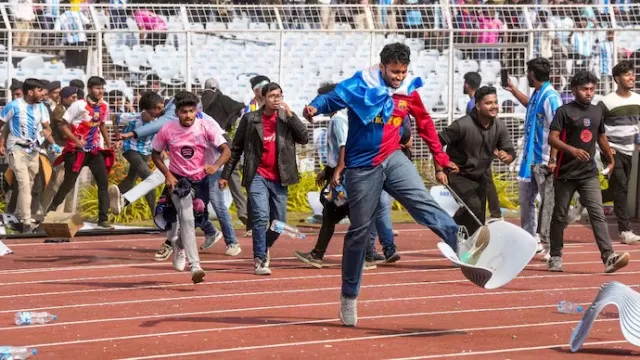
Lionel Messi’s much-anticipated visit to Kolkata, meant to be a celebratory moment for football fans in India, spiralled into chaos and controversy, exposing serious lapses in planning, crowd control, and governance. What was billed as a once-in-a-lifetime opportunity to witness the global football icon turned into scenes of anger and vandalism at the iconic Salt Lake Stadium, leaving fans disillusioned and authorities scrambling for answers.
As images and videos of the unrest spread rapidly on social media, the political fallout was swift and significant. The episode culminated in the resignation of West Bengal Sports Minister Aroop Biswas, marking one of the most high-profile consequences of an event management failure in the state’s recent history. The controversy has also placed the ruling Trinamool Congress under intense scrutiny ahead of crucial assembly elections.
Beyond the immediate chaos, the incident has sparked a larger debate on accountability, public event management, and the fine line between celebrity spectacle and public responsibility. With Chief Minister Mamata Banerjee stepping in to directly oversee the Sports and Youth Welfare Department, the episode has reshaped the political and administrative narrative surrounding sports governance in West Bengal.
Messi’s Kolkata Visit Turns Chaotic at Salt Lake Stadium
The turmoil erupted when thousands of fans gathered at Salt Lake Stadium with hopes of catching a glimpse of Lionel Messi during his much-publicised visit. Many spectators had reportedly paid premium prices for tickets, some shelling out as much as ₹15,000, driven by the promise of witnessing the Argentine legend in person. However, expectations quickly turned into frustration as Messi’s appearance was brief and heavily restricted.
Fans alleged that Messi was surrounded by a select group of politicians, organisers, and influential individuals, leaving ordinary ticket-holders stranded far from the action. As minutes passed without any meaningful interaction or visibility, tempers flared inside the stadium. Bottles were thrown, plastic seats were ripped out, and sections of the venue were vandalised, forcing authorities to intervene.
The chaos not only disrupted the event but also raised uncomfortable questions about crowd management, security preparedness, and whether organisers had underestimated the emotional investment of fans eager to see one of football’s greatest players.
Resignation of Sports Minister Aroop Biswas
The political consequences of the fiasco were swift. West Bengal Sports Minister Aroop Biswas submitted his resignation after the state government ordered a formal investigation into the mismanagement surrounding the event. In a handwritten letter to Chief Minister Mamata Banerjee, Biswas stated that he was stepping down to ensure a free and fair inquiry into the incident.
Chief Minister Mamata Banerjee accepted his resignation from the sports portfolio, though Biswas will continue to serve as a cabinet minister handling the power department. The move was widely seen as an attempt by the government to demonstrate accountability and limit further political damage amid growing public anger.
Biswas, considered one of Mamata Banerjee’s trusted aides, had faced mounting criticism for the failure of the event. His resignation underscored the seriousness with which the ruling party treated the fallout, particularly with elections looming on the horizon.
Mamata Banerjee Takes Direct Charge of Sports Department
Following Biswas’s exit from the sports portfolio, Trinamool Congress spokesperson Kunal Ghosh announced that Chief Minister Mamata Banerjee would take direct charge of the Sports and Youth Welfare Department for the time being. The decision was aimed at restoring confidence and ensuring tighter oversight of future sporting events in the state.
Sources indicated that Banerjee was visibly displeased with how the Messi event had unfolded, viewing it as an embarrassment that damaged the state’s image nationally and internationally. During closed-door meetings, she reportedly stressed the importance of responsibility and warned officials against allowing mismanagement to tarnish West Bengal’s reputation.
By assuming direct control, the Chief Minister signalled a hands-on approach, reinforcing her image as an administrator unwilling to tolerate lapses, especially when public sentiment and the state’s global perception are at stake.
Government Inquiry and Action Against Officials
In response to the unrest, the West Bengal government constituted an inquiry panel headed by retired Justice Asim Kumar Roy. A preliminary report submitted by the panel highlighted multiple lapses in coordination, security, and crowd control, prompting swift administrative action against several senior officials.
Director General of Police Rajeev Kumar was served a show-cause notice and asked to explain the security failures within 24 hours. Similar notices were issued to the Bidhannagar police chief and the principal secretary of the sports department, indicating that accountability would extend beyond political leadership to the administrative machinery.
Further action included the suspension of Deputy Commissioner of Police Aneesh Sarkar, reinforcing the government’s stance that operational failures would not be overlooked. These measures were intended to reassure the public that the incident was being treated with the seriousness it deserved.
Fan Anger, Arrests, and Social Media Fallout
The immediate aftermath of the chaos saw heightened police presence and the arrest of Satadru Dutta, the chief organiser of the event. Fans accused organisers of overpromising and underdelivering, alleging that the event was poorly planned and designed to prioritise VIP access over genuine fan engagement.
Videos of vandalised seating and angry crowds quickly went viral, triggering widespread criticism on social media platforms. Many users questioned how an event involving a global icon like Messi could be handled with such apparent negligence, while others demanded refunds and stricter regulations for large-scale public events.
The backlash extended beyond Kolkata, with football fans across the country expressing disappointment and concern over how international sporting personalities are presented to Indian audiences.
Political Reactions and Opposition Criticism
The opposition Bharatiya Janata Party wasted no time in attacking the Trinamool Congress government, citing the Messi event fiasco as evidence of administrative incompetence. BJP leaders accused the state government of prioritising optics over proper planning and safety.
The ruling party, however, defended its actions by pointing to the resignation of the sports minister and the inquiry against officials as proof of its commitment to accountability. TMC leaders argued that corrective measures were already underway and that the government was determined to prevent a repeat of such incidents.
Nevertheless, the episode has intensified political tensions in the state, becoming a talking point as parties gear up for the upcoming assembly elections.
Lessons for Future Mega Sporting Events
The Messi Kolkata fiasco has emerged as a cautionary tale for organisers and governments alike. Large-scale events featuring global icons require meticulous planning, transparent communication, and robust security arrangements to manage public expectations and ensure safety.
Experts argue that clear protocols for crowd movement, visibility arrangements, and fan interaction are essential to avoid disappointment turning into unrest. The incident has also highlighted the need for stricter oversight of private organisers involved in hosting international stars.
As West Bengal looks ahead, the challenge lies in rebuilding trust among fans and demonstrating that the state can host world-class sporting events without compromising on organisation or public safety.
A Political and Cultural Turning Point
What began as a celebration of football and global stardom ended as a defining political moment in West Bengal. The resignation of a senior minister, direct intervention by the Chief Minister, and disciplinary action against top officials have ensured that the incident will have lasting repercussions.
For fans, the disappointment of missing out on seeing Lionel Messi up close remains raw. For the government, the episode serves as a reminder that public sentiment can shift rapidly when expectations are not met.
As investigations continue and reforms are promised, the Messi event fiasco stands as a stark example of how sport, politics, and public emotion intersect — sometimes with explosive consequences.
Also Read: Who Is Kartik Sharma? CSK’s ₹14.2 Cr Auction Sensation



Disclaimer
Possible11 is a sports news and analysis platform designed purely for entertainment and educational purposes. All match previews, player insights, and team analyses are based on publicly available information and expert opinions. We do not promote or support betting, gambling, or real-money gaming in any form. Users are encouraged to enjoy our content responsibly and use it for informational purposes only.
Give Your Feedback