

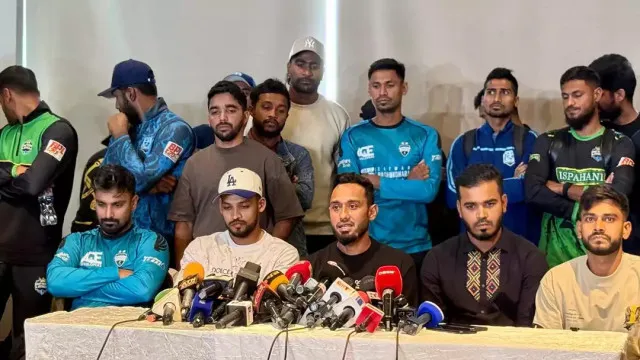
The past few days have been among the most turbulent in recent Bangladeshi cricket history, and at the centre of the storm stood Cricketers' Welfare Association of Bangladesh (CWAB) president Mohammad Mithun. What began as a public swipe from a senior board official spiralled into a full-blown crisis, triggering boycott threats from players, postponement of Bangladesh Premier League matches, and intense behind-the-scenes negotiations that tested the very foundations of player representation in the country.
Visibly exhausted after nearly 48 hours of continuous discussions, uncertainty, and personal pressure, Mithun chose to speak candidly about the episode. His words revealed not only the strain of leadership during a crisis but also the larger structural challenges faced by players when they attempt to collectively assert their rights within a high-stakes professional ecosystem.
The episode, while eventually defused, has left lingering questions about governance, communication gaps, and the personal toll exacted on those who step forward to represent collective interests. Mithun’s reflections offer a rare, unfiltered look into how fragile the balance between authority, accountability, and welfare can become when trust breaks down.
How a public dispute escalated into a full-blown crisis
The controversy erupted following a public remark by a senior cricket board director, which was perceived by players as dismissive and disrespectful. In an environment already sensitive due to scheduling pressures and unresolved welfare concerns, the comment acted as a spark in dry tinder. Within hours, discussions intensified among players, with many questioning whether their voices were being adequately heard or valued.
The Cricketers' Welfare Association of Bangladesh, newly led by Mohammad Mithun, found itself at the forefront of this unrest. As talks of a boycott gained momentum, the scheduled Bangladesh Premier League fixtures on January 15 were postponed, sending shockwaves through administrators, franchises, and fans alike. The situation demanded immediate intervention, not only to save the tournament but also to address deeper grievances.
What followed were marathon negotiation sessions marked by emotional exchanges, firm stances, and eventual compromises. While the immediate trigger was resolved with the removal of the director in question, the episode exposed fault lines that had been quietly widening for years.
Compromise over confrontation for the sake of the game
Reflecting on the outcome, Mithun was clear that the resolution did not fully align with CWAB’s initial demands. The association began the process with a firm position, driven by the belief that setting precedents was crucial for long-term player welfare. However, as the situation evolved, the potential consequences of prolonged rigidity became evident.
The prospect of the league being indefinitely stalled weighed heavily on the association’s leadership. Mithun acknowledged that while standing firm is important, leadership also requires recognising when compromise serves a greater good. Ensuring that cricket continued, and that players retained their livelihoods and competitive momentum, ultimately took precedence.
This balance between ideal outcomes and practical realities is a recurring challenge in sports governance. Mithun’s admission underscores the complexity of representing diverse player interests while navigating institutional constraints.
Trust, commitments, and the fear of betrayal
Central to CWAB’s decision to step back from the brink was the set of assurances offered during negotiations. Mithun expressed cautious optimism, choosing to trust the commitments made for the continuation of the league and the broader interests of cricket. Yet, he did not shy away from acknowledging the stakes involved if those promises were broken.
Any failure to honour commitments, he noted, would amount to a betrayal not of the association but of the players themselves. The episode, therefore, was never just about a single tournament. It was about establishing whether dialogue and assurances could still function as effective tools within the system.
By framing the issue as one concerning cricket as a whole rather than just the BPL, Mithun highlighted the association’s broader mandate and the long-term implications of trust between players and administrators.
Uncertainty surrounding disciplinary action
Questions also lingered about the status of the director whose remarks ignited the controversy. According to Mithun, communication with the individual had ceased, prompting the initiation of formal procedures. Letters were sent, deadlines established, and committees formed to address the issue systematically.
This phase of the process introduced a sense of procedural gravity to the situation. Rather than relying solely on verbal assurances, the association sought visible action, a move intended to reassure players that their concerns were being taken seriously.
While the outcome of these proceedings remained pending at the time, the initiation itself marked an important step toward accountability, reinforcing the idea that public conduct by officials carries consequences.
Beyond the BPL: broader welfare concerns raised
The crisis also provided CWAB with an opportunity to raise long-standing issues beyond the immediate controversy. Matters related to Dhaka First Division cricket scheduling, women players’ safety, and transparency around BPL draft exclusions were brought to the table.
According to Mithun, these concerns were not dismissed outright. While timelines varied, there was acknowledgment that action was necessary. Some issues were already slated for discussion, while others were promised visibility through tangible steps in the near future.
This broader engagement underscored the association’s intent to leverage moments of crisis to push for structural improvements rather than settling for isolated fixes.
Life threats and the personal cost of leadership
Perhaps the most disturbing revelation was Mithun’s admission that he had received life threats during the ordeal. For someone unaccustomed to controversy, the experience was deeply unsettling. He expressed disbelief at being targeted for advocating player interests, questioning how calls for welfare could be misconstrued as acts against the nation.
The psychological toll was evident in his words. Navigating uncharted territory without prior exposure to such hostility left him unsure of how to respond or seek help. Avoiding unknown calls became a coping mechanism, even as messages continued to arrive through other channels.
Mithun also revealed that he was not alone, with other players reportedly receiving threats as well. This aspect of the crisis added a sobering dimension, highlighting the risks faced by those who step into representative roles.
Balancing responsibility, fear, and conviction
Despite the intimidation, Mithun remained firm in his belief that his role demanded speaking up. He questioned the very purpose of holding the presidency if it meant remaining silent in the face of player concerns. His stance reflected a conviction that leadership is inherently tied to advocacy, even when it invites personal risk.
Drawing a cricketing analogy, Mithun likened the situation to facing an unfamiliar delivery, one he had never encountered in his playing career. The metaphor captured both his vulnerability and his determination to adapt, learn, and respond thoughtfully rather than react impulsively.
This candid admission humanised the often-abstract notion of player representation, reminding observers that behind organisational titles are individuals grappling with fear, doubt, and responsibility.
Addressing perceptions and internal dynamics
The crisis also reignited speculation about behind-the-scenes influences within CWAB. Mithun addressed perceptions that senior players wield undue control, firmly rejecting the notion that decisions were dictated by any individual.
He emphasised that the association operates collectively, guided by majority opinion and structured processes. While senior figures may offer advice, decision-making authority rests with the organisation as a whole, ensuring that no single voice dominates.
By clarifying this dynamic, Mithun aimed to reinforce the legitimacy and independence of CWAB, countering narratives that undermine its credibility.
Majority rule and the reality of player unity
Responding to suggestions that internal disagreements hindered decisive action, Mithun acknowledged the diversity of opinions among players. In any large group, unanimity is rare, particularly when career security and personal circumstances vary widely.
His approach prioritised majority consensus, recognising that leadership sometimes means moving forward despite dissent. This pragmatic stance reflected an understanding of the pressures faced by younger players, many of whom may hesitate to speak openly.
Ultimately, Mithun framed decision-making as a responsibility to represent the broader collective, even when it involves difficult choices.
Looking ahead amid global commitments
With major international tournaments on the horizon, questions naturally arose about player safety and participation. Mithun stressed that while representing the country is a profound honour, it should never come at the cost of personal security.
He expressed hope that governing bodies and authorities would act decisively to ensure a safe environment, enabling players to focus on performance rather than fear. Balancing national pride with welfare considerations remains a delicate task.
The episode has served as a reminder that preparation for global events extends beyond training camps and logistics; it also involves creating conditions where players feel protected and respected.
Lessons for the future of cricket governance
In reflecting on whether the crisis could have been avoided, Mithun pointed to the importance of proactive governance. Acknowledgment of mistakes by officials was a positive step, but prevention remains the ultimate goal.
Effective communication, early intervention, and accountability mechanisms can help avert situations from escalating to the brink of disruption. Mithun expressed confidence that with greater responsibility and vigilance, similar incidents can be avoided.
As the dust settles, the episode stands as both a cautionary tale and an opportunity for reform, offering valuable lessons for the evolving relationship between players, administrators, and the institutions that bind them together.
Also Read: Can Arsenal Do an RCB in the 2025-26 Football Season











Disclaimer
Possible11 is a sports news and analysis platform designed purely for entertainment and educational purposes. All match previews, player insights, and team analyses are based on publicly available information and expert opinions. We do not promote or support betting, gambling, or real-money gaming in any form. Users are encouraged to enjoy our content responsibly and use it for informational purposes only.









Give Your Feedback