

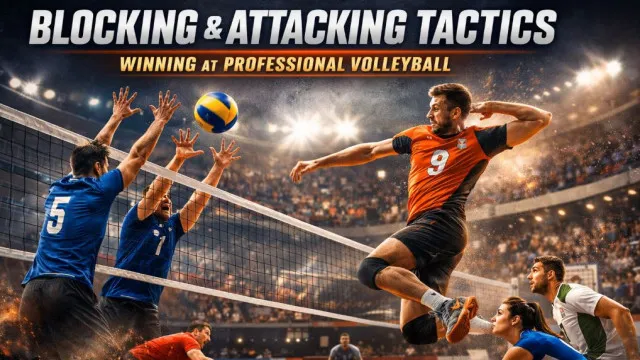
At the professional level, volleyball is no longer a game decided by raw athleticism alone. Success depends on tactical clarity, precise coordination, and the ability to read opponents in real time. Among all technical elements, blocking and attacking form the core of winning strategies. These two phases are deeply interconnected: effective blocking disrupts opponents’ rhythm, while intelligent attacking exploits even the smallest defensive weakness.
Modern volleyball has evolved into a fast, data-driven sport where teams constantly adapt their blocking schemes and attacking patterns. Understanding how these systems work together explains why certain teams dominate at the highest level while others struggle despite individual talent.
The Tactical Relationship Between Blocking and Attacking
Blocking and attacking are not isolated actions. A well-organized block shapes the opponent’s attacking decisions, while a diverse attack forces defenders into constant adjustment. Professional teams design their game plans around this interaction rather than treating skills separately.
At elite tournaments, coaches and analysts break down tendencies such as preferred hitting angles, setter habits, and transition speed. This tactical depth is why volleyball analysis has gained interest even outside traditional coaching circles, including on competitive sports platforms like playbison, where strategic understanding often mirrors professional-level thinking.
Modern Blocking Systems in Professional Volleyball
Blocking has shifted from reactive jumping to proactive positioning. Teams no longer rely solely on height; timing, reading the setter, and lateral movement are now decisive factors.
Common blocking systems include:
- Commit block, where the middle blocker commits early to a quick attack
- Read-and-react block, where blockers delay their jump to read the set
- Spread block, designed to take away sharp angles rather than full coverage
Each system is chosen based on the opponent’s offensive profile and the blockers’ physical attributes.
| Blocking System | Primary Objective |
| Commit block | Stop fast middle attacks |
| Read-and-react | Adapt to unpredictable setters |
| Spread block | Force high, less efficient hits |
No system is universally superior; flexibility and in-game adjustment separate elite defenses from average ones.
Key Principles of Effective Blocking
Professional blocking success depends on collective execution rather than individual heroics. Even the best blockers rely heavily on back-row defenders positioned according to the block’s shape.
Core blocking principles include:
- Precise footwork and lateral speed
- Late hand penetration over the net
- Clear communication between middle and wing blockers
- Consistent alignment with back-row defense
A block does not need to score points directly to be effective. Soft touches, deflections, and forced roll shots are often more valuable than clean stuff blocks.
Advanced Attacking Tactics at the Pro Level
Attacking in modern volleyball is about unpredictability. Power remains important, but placement, timing, and deception now play a greater role in breaking organized defenses.
Professional attackers focus on:
- Tooling the block rather than hitting straight through it
- Using off-speed shots to disrupt defensive rhythm
- Exploiting seams between blockers
- Adjusting approach angles based on block positioning
Setters are central to this process, as they control tempo and disguise offensive intentions.
| Attacking Option | Tactical Purpose |
| Quick sets | Neutralize tall blocks |
| Back-row attacks | Stretch defensive systems |
| Roll shots | Exploit deep defensive gaps |
| High balls | Reset structure under pressure |
The best offenses are not the most powerful, but the most adaptable.
Transition Play: Where Matches Are Often Won
The transition phase—moving from defense to offense—is where blocking and attacking truly merge. A successful block touch often creates a chaotic defensive situation for the opponent, allowing for faster counterattacks.
Strong transition teams share several traits:
- Rapid setter movement after defensive actions
- Predefined transition routes for attackers
- Middle blockers staying active after block attempts
- Decision-making within one or two seconds
This phase rewards discipline and anticipation more than raw speed.
Tactical Adjustments During Matches
Professional matches are defined by constant micro-adjustments. Coaches rarely change entire systems mid-match, but subtle shifts can have major effects.
Typical adjustments include:
- Changing blocking priorities toward a hot hitter
- Altering serve targets to disrupt attacking timing
- Modifying attack distribution to isolate weaker blockers
- Adjusting defensive depth behind the block
Teams that recognize patterns faster than their opponents usually control momentum, even if rallies remain close.
Why Blocking and Attacking Define Winning Teams
Statistics consistently show that teams winning the blocking–attacking battle control matches at the professional level. However, this dominance is rarely obvious on the surface. It appears in forced errors, predictable swings, and increasingly cautious opponents.
Elite teams do not aim to block every ball or score on every attack. Instead, they focus on:
- Reducing opponent efficiency
- Creating high-quality attacking opportunities
- Maintaining tactical pressure over long stretches
This cumulative advantage is what separates champions from contenders.
Final Thoughts
Winning at professional volleyball requires more than height, power, or isolated skill. Blocking and attacking tactics form an integrated system built on anticipation, communication, and adaptability. The most successful teams are those that understand this balance and execute it consistently under pressure.
As volleyball continues to evolve, tactical intelligence will only grow in importance. Teams that master the subtle interplay between blocking structure and attacking creativity set the standard for modern professional success.











Disclaimer
Possible11 is a sports news and analysis platform designed purely for entertainment and educational purposes. All match previews, player insights, and team analyses are based on publicly available information and expert opinions. We do not promote or support betting, gambling, or real-money gaming in any form. Users are encouraged to enjoy our content responsibly and use it for informational purposes only.










Give Your Feedback