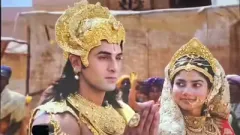
Prabhas’ much-hyped return to lighter, genre-blending cinema with The Rajasaab arrives carrying the promise of novelty and nostalgia. Positioned as a horror-comedy fantasy, the film seeks to pull the actor away from his post-Baahubali action-heavy image and back into a space of humour, romance, and theatrical eccentricity. On paper, it sounds like a refreshing pivot.
In execution, however, the film collapses under the weight of its own confusion. Instead of delivering either scares or laughs, it settles into an exhausting loop of noise, incoherence, and outdated storytelling. What emerges is a cinematic experience that feels less like a bold experiment and more like a relic struggling to justify its relevance.
With wafer-thin characters, regressive ideas, and scenes stitched together without emotional logic, The Rajasaab ends up testing audience patience far more than their appetite for genre cinema.
An ambitious genre experiment that lacks clarity
Director Maruthi appears intent on fusing horror, fantasy, romance, and slapstick comedy into a single narrative. Such genre mashups are not new to Telugu cinema, and when executed with conviction, they can be wildly entertaining. Unfortunately, The Rajasaab never decides what it wants to be.
At different moments, the film flirts with horror tropes, leans into juvenile comedy, and attempts emotional drama, but none of these strands are developed enough to hold attention. The tonal shifts are abrupt and often unintentionally comical, making the film feel like a patchwork rather than a cohesive story.
Paper-thin characters and narrative shortcuts
The characters in The Rajasaab are sketched so lightly that they barely exist beyond their costumes and dialogue. Raju, played by Prabhas, is introduced as a dutiful grandson accompanying his grandmother, Ganga Devi, who suffers from memory loss. Yet their emotional bond is never convincingly established.
Supporting characters drift in and out of the narrative without purpose. Motivations are announced rather than shown, and revelations arrive late, stripped of any emotional impact. The screenplay seems perpetually in a hurry, rushing from one scene to the next without pausing to build tension or empathy.
Women reduced to decorative presences
One of the film’s most glaring weaknesses is its treatment of female characters. Women exist largely as romantic distractions or visual embellishments, orbiting the male protagonist without agency or depth. Their presence adds little beyond superficial glamour.
Romantic arcs are rushed and illogical, with characters falling in love at first glance and abandoning lifelong commitments without hesitation. The absence of meaningful interactions between women further highlights how outdated and regressive the writing feels.
A promising backstory that goes nowhere
The backstory involving Ganga Devi and the antagonist played by Sanjay Dutt holds the seeds of compelling horror and emotional drama. There are glimpses of betrayal, injustice, and psychological torment that could have anchored the film.
Yet the narrative barely scratches the surface. Key emotional beats are glossed over, and potentially chilling moments are diluted by ill-timed jokes or abrupt tonal shifts. What could have been the film’s spine instead becomes an underdeveloped footnote.
A dull and disjointed first half
The first half of The Rajasaab struggles to find momentum. Prabhas’ much-anticipated introduction lacks impact, staged with surprising dullness. His entry is followed by a repetitive cycle of moral lectures, random action sequences, and forgettable songs.
Rather than setting the stage or establishing stakes, these sequences sap energy from the film. The absence of narrative progression makes the runtime feel far longer than it already is.
Second half offers brief sparks, not salvation
The second half finally attempts to settle into a storyline, shifting much of the action to a supposedly haunted mansion. A few comic actors manage to extract fleeting laughs, briefly recalling better horror-comedy efforts from the past.
However, these moments are too little and too late. The tension never builds, the fear never lingers, and the humour rarely lands. The haunted setting feels more like a themed resort than a place of dread.
Production design without emotional grounding
The film’s sets and visual design are elaborate, filled with statues, spiral motifs, and grand interiors. While visually striking at times, the artificiality of these spaces is impossible to ignore. The world never feels lived-in or authentic.
Even when the story moves to a dilapidated mansion deep in the forest, the sense of danger remains absent. Characters behave as though they are on a casual outing rather than trapped in a supernatural nightmare.
Visual effects and horror diluted by comedy
The Rajasaab borrows visual cues from earlier horror films, with occasional jump scares and digital creatures meant to shock the audience. Yet every attempt at fear is quickly undercut by slapstick humour or casual dialogue.
The result is a film that fails to commit to horror, offering neither sustained tension nor genuine scares. The visual effects, though occasionally impressive, cannot compensate for the lack of atmosphere.
Music that adds noise, not emotion
The film’s music does little to elevate the narrative. The songs are largely forgettable, interrupting the flow without adding charm or depth. The background score, especially during the climax, relies on sheer loudness.
Instead of enhancing emotion or suspense, the music often feels like an assault on the senses, amplifying the film’s overall sense of excess.
Prabhas struggles to carry the burden
Prabhas makes an earnest attempt to embrace comedy and lighter moments, but the material gives him little to work with. His performance feels drained, with expressions that rarely rise above monotony.
Post-Baahubali, the actor’s screen presence seems to be searching for direction, and The Rajasaab does little to restore his spark. Inconsistent styling and uneven dialogue delivery further distract from his performance.
Supporting cast left adrift
The supporting cast, including experienced performers, is largely wasted. Characters appear briefly, hint at complexity, and then fade away without resolution. Even seasoned actors are unable to inject life into roles that lack substance.
The three leading women, in particular, are burdened with flimsy characterisation that offers no scope for meaningful performance.
An overlong climax and sequel tease
The climax stretches endlessly, attempting to stage a battle of wits and supernatural forces. By this point, the film has exhausted whatever goodwill the audience may have had.
The announcement of a sequel lands not as an exciting prospect, but as an unwelcome surprise. What is meant to be a promise of more feels instead like a threat.
A loud, lazy, and outdated affair
The Rajasaab aspires to be a crowd-pleasing entertainer, but its incoherent storytelling, outdated sensibilities, and lack of conviction undermine that ambition. The film mistakes volume for impact and spectacle for substance.
In the end, it stands as a cautionary tale about genre experimentation without clarity or craft. What could have been a refreshing detour for Prabhas instead becomes an endurance test for viewers, leaving behind the lingering question of why such a noisy spectacle has so little to say.
Also Read: India Trade Deal Stalled As Modi Did Not Call Trump