Bangladesh is witnessing one of its most volatile phases in recent years, with political unrest, communal tensions and diplomatic fallout converging into a widening crisis. What began as isolated incidents of violence has now evolved into nationwide protests, attacks on institutions and an uneasy standoff with India, raising serious concerns across South Asia.
The ripple effects are no longer confined within Bangladesh’s borders. Diplomatic friction, suspension of visa services, and street protests in India underline how internal instability has transformed into a regional flashpoint. As pressure mounts on the interim government, multiple actors are now shaping a rapidly unfolding and unpredictable situation.
At the centre of this turmoil are unresolved questions of justice, governance and public trust. From mob violence and minority insecurity to threats against the media and mass political mobilisation, the unrest reflects deeper structural fractures that continue to widen by the day.
Inquilab Mancho’s Ultimatum to the Interim Government
The protest platform Inquilab Mancho, spearheaded by associates of slain activist Osman Hadi, has emerged as a powerful force challenging the interim administration. The group has openly threatened a nationwide mass movement if swift justice is not delivered, signalling a dramatic escalation in political pressure.
Leaders associated with the platform argue that the government has failed to act decisively on high-profile killings and has lost moral authority. Their demands include the formation of special trial mechanisms, accountability for security lapses, and the possibility of involving foreign investigators to ensure transparency.
This ultimatum has placed the interim government in a precarious position, as conceding risks undermining sovereignty while refusal could trigger sustained street mobilisation capable of paralysing governance.
Unrest Spills Beyond Borders as Diplomatic Tensions Rise
Bangladesh’s internal unrest has begun spilling across borders, prompting the suspension of visa services at its High Commission in New Delhi and missions in Tripura and Siliguri. Officials cited security concerns following protests near diplomatic premises, a move that underscored the seriousness of the situation.
India responded by summoning Bangladesh’s envoy and conveying strong objections over attacks on minorities and threats to diplomatic missions. The exchange highlighted growing unease in New Delhi over the safety of vulnerable communities and diplomatic staff.
This diplomatic face-off marks a significant downturn in bilateral relations, with both sides under pressure to manage public sentiment while preventing further escalation.
Kolkata Protests Reflect Cross-Border Outrage
The fallout has been visibly felt on the streets of Kolkata, where large-scale protests erupted outside the Bangladesh High Commission. Demonstrators voiced anger over reports of lynching and communal violence in Bangladesh, calling for accountability and international attention.
Led by members of Hindu organisations and political figures, the protests reflected a blend of humanitarian concern and political mobilisation. Protest leaders warned that agitation could intensify, including symbolic actions and potential disruptions near border areas.
The demonstrations underscored how developments in Bangladesh resonate deeply within India, particularly in border states with historical, cultural and familial ties.
The Lynching That Shook Bangladesh
At the heart of the unrest lies the brutal killing of Dipu Chandra Das, a Hindu garment worker in Mymensingh. He was allegedly dragged from his workplace by a mob, beaten, hung and set on fire, a sequence of events that shocked the nation.
Authorities have stated that the killing unfolded over several hours, raising serious questions about delayed intervention and systemic failure. The incident has become emblematic of a breakdown in law and order and has intensified scrutiny of policing practices.
The brutality of the act ignited widespread protests, transforming a local tragedy into a national and international flashpoint.
Blasphemy Allegations Collapse Under Investigation
Initial claims that the victim had made blasphemous remarks or online posts were found to be unsupported by evidence. Investigators have since revealed that no verified material existed to justify the accusations.
Authorities now believe the blasphemy narrative may have been used as a pretext, with a workplace dispute emerging as a more plausible trigger. This revelation has further inflamed public anger and raised concerns over the misuse of religious sentiments.
The collapse of the blasphemy claim has intensified calls for legal reform and safeguards against mob justice.
Arrests Highlight Institutional Failures
Several arrests have been made in connection with the lynching, including factory supervisors and co-workers. Investigators allege that instead of alerting law enforcement, the victim was forced to resign and pushed out of the premises.
Officials have stated that this delay proved fatal, underscoring how institutional negligence can amplify violence. The arrests have brought renewed focus on workplace accountability and employer responsibility.
Legal proceedings in the case are being closely watched as a test of the interim government’s commitment to justice.
Osman Hadi’s Death Sparks Nationwide Protests
The killing of Osman Hadi, a prominent figure from last year’s uprising, has acted as another catalyst for unrest. Shot in Dhaka and later succumbing to his injuries abroad, Hadi’s death transformed him into a symbol of resistance for many protesters.
Demonstrations following his death spread rapidly across cities, with supporters accusing the state of silencing dissent. His assassination has deepened mistrust between citizens and authorities.
For radical groups, Hadi’s death has become a rallying point to demand systemic change.
Attacks on Media and Threats to Press Freedom
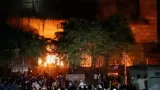
Media houses have not been spared from the violence. Offices of major newspapers were vandalised and set ablaze, with journalists reportedly trapped inside burning buildings for hours.
Editors and press bodies have condemned the attacks as attempts to intimidate and silence independent reporting. The incidents have raised alarms about shrinking space for free expression.
The targeting of journalists marks a dangerous turn, suggesting that unrest is no longer limited to political confrontation but extends to democratic institutions.
Minorities Take to the Streets Amid Rising Fear
Minority communities, particularly Hindus, have staged protests accusing the interim government of failing to ensure their safety. Many report a climate of fear and uncertainty following repeated incidents of targeted violence.
Rights groups warn that minority insecurity has worsened amid political instability, eroding confidence in state protection. Demonstrators have called for stronger safeguards and visible enforcement.
The issue of minority rights has now become central to both domestic protests and international scrutiny.
Election Promise Faces Growing Skepticism
Interim leader Muhammad Yunus has reiterated that general elections will be held on the promised date, asserting that the government is prepared to manage security challenges.
Critics, however, question whether free and fair polls are feasible amid assassinations, mob violence and sustained unrest. Concerns persist over voter safety and institutional readiness.
As Bangladesh navigates this turbulent period, the coming weeks will be critical in determining whether stability can be restored or whether the crisis will deepen further.
Also Read: Indian H-1B Workers Reconsider Travel Amid Vetting Delays