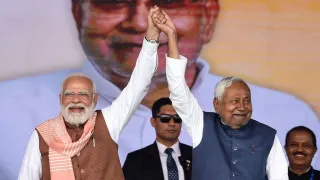
Congress leader Adhir Ranjan Chowdhury’s meeting with Prime Minister Narendra Modi in New Delhi has stirred political interest, especially with West Bengal heading towards Assembly elections in the coming months. The interaction, held at the Prime Minister’s official residence, comes at a time when electoral processes and voter-related issues have become a focal point of intense debate in the state.
According to media reports, the meeting covered a wide range of concerns, reflecting growing unease within sections of the opposition over recent administrative and electoral developments. From apprehensions about voter list revisions to reports of violence targeting Bengali-speaking people outside the state, the discussions appear to have touched upon issues with both regional and national implications.
While official details of the meeting remain limited, its timing and context have added to speculation about its significance, particularly against the backdrop of protests, political mobilisation, and heightened scrutiny of electoral exercises in West Bengal.
Meeting gains importance ahead of Bengal Assembly polls
The meeting between Adhir Ranjan Chowdhury and Prime Minister Modi assumes special importance as West Bengal prepares for Assembly elections scheduled for March–April next year. With political parties already positioning themselves, any engagement between senior opposition leaders and the Prime Minister is being closely watched.
For the Congress, which has been striving to retain relevance in the state’s political landscape, raising concerns directly with the Prime Minister signals an attempt to highlight issues that it believes could influence the electoral environment.
Observers note that such meetings often serve multiple purposes, including conveying grievances, seeking assurances, and drawing national attention to state-specific matters.
Concerns over Special Intensive Revision of electoral rolls
One of the key issues reportedly discussed was the Special Intensive Revision of electoral rolls currently underway in West Bengal. The exercise has sparked widespread debate and protests, particularly after the publication of the draft voters list.
Opposition parties have expressed apprehension that the revision process could lead to large-scale disenfranchisement if not conducted with transparency and adequate safeguards. These concerns have resonated strongly in urban centres like Kolkata as well as in smaller towns across the state.
By raising the issue at the highest political level, Chowdhury is believed to have sought clarity and reassurance regarding the fairness and inclusiveness of the revision process.
Protests erupt across West Bengal
Since the release of the draft electoral rolls, West Bengal has witnessed numerous protests, many of them led by the ruling Trinamool Congress. Demonstrations have highlighted fears that eligible voters could be excluded due to documentation issues or administrative errors.
Large gatherings were reported not only in Kolkata but also in district headquarters and smaller towns, reflecting the scale of public concern. Protesters have demanded greater transparency and adequate time for citizens to verify and correct their details.
The intensity of these protests has added political pressure on the Election Commission and heightened tensions in an already charged pre-election atmosphere.
Hearings for unmapped voters begin
Hearings under the Special Intensive Revision process began recently, with people lining up at thousands of centres across West Bengal. According to officials, these hearings are aimed at addressing the status of so-called unmapped voters.
Unmapped voters are those who are unable to establish a linkage with earlier electoral rolls, particularly the 2002 roll. In the first phase alone, around 32 lakh such voters are expected to be called for hearings.
The scale of the exercise underscores the administrative challenge involved and explains why political parties are closely monitoring its implementation.
Role of micro observers and documentation process
To oversee the hearings, thousands of micro observers have been deployed across the state. Their role is to ensure that procedures are followed correctly and that voters are given a fair opportunity to present their case.
Voters have been allowed to submit any of 12 recognised documents as proof of identity and address, including Aadhaar. Election officials have stated that these measures are intended to make the process accessible and inclusive.
Despite these assurances, political leaders continue to question whether the system can adequately prevent errors or misuse on such a large scale.
Deletion of voter names raises alarm
The Election Commission published the draft electoral rolls after completing the revision exercise, revealing that over 58 lakh voter names had been deleted. The deletions were attributed to reasons such as death, migration, and non-submission of enumeration forms.
This large number has become a flashpoint in the political discourse, with opposition parties arguing that genuine voters could be unfairly excluded. The issue has also fueled mistrust and anxiety among sections of the electorate.
Chowdhury’s reported discussion with the Prime Minister is seen as part of efforts to address these fears at the national level.
Violence against Bengali-speaking people discussed
Another issue reportedly raised during the meeting was incidents of violence against Bengali-speaking people in several states. These incidents have drawn concern from political leaders and civil society groups alike.
Such reports have added a broader dimension to the discussion, moving it beyond electoral mechanics to questions of social harmony and the safety of linguistic communities.
By highlighting these incidents, Chowdhury is believed to have emphasised the need for stronger safeguards and a clear message against discrimination and targeted violence.
Congress strategy and political messaging
For the Congress, the meeting serves as an opportunity to position itself as a party raising substantive concerns rather than merely reacting to political developments. Chowdhury, one of the party’s most prominent faces in Bengal, has consistently taken up issues related to governance and democracy.
Engaging directly with the Prime Minister allows the Congress to claim that it is actively seeking solutions through institutional channels, even as it continues to mobilise politically on the ground.
This approach also helps the party maintain visibility in a state where political space is fiercely contested.
Broader implications for electoral integrity
The discussions around electoral roll revision have wider implications for the integrity of elections, not just in West Bengal but across the country. How such exercises are conducted and perceived can significantly influence public trust in democratic processes.
Concerns raised by opposition leaders highlight the importance of transparency, communication, and grievance redressal in large-scale administrative exercises.
The outcome of these debates could set precedents for how similar revisions are handled in other states in the future.
Political climate intensifies ahead of elections
As the election season approaches, political temperatures in West Bengal are expected to rise further. Meetings like the one between Chowdhury and Modi add to the evolving narrative, shaping perceptions and strategies on all sides.
While the ruling parties focus on governance and administrative processes, opposition groups are likely to continue spotlighting potential flaws and demanding accountability.
This dynamic is set to define the political discourse in the months leading up to the polls.
Looking ahead
Though the immediate outcomes of the meeting remain unclear, its significance lies in the issues it brought to the forefront. Electoral integrity, voter inclusion, and social harmony are themes that resonate far beyond party lines.
As hearings continue and political campaigning gathers momentum, how authorities address these concerns will be closely watched by citizens and political observers alike.
The meeting between Adhir Ranjan Chowdhury and Prime Minister Narendra Modi thus stands as a key moment in the unfolding political story of West Bengal’s upcoming Assembly elections.
Also Read: Racial Slur Killed Youth in Dehradun Tripura Link Shocks